Well, I finally got around to getting all of my photos and videos processed so I can present you with the much anticipated James Bay report, Chickney edition! I was lucky enough to be part of the crew doing some of the shorebird surveys on James Bay as part of an ongoing joint MNR/CWS/ROM project monitoring Red Knots and other shorebirds utilizing the massive mudflats of western James Bay during fall migration.
We took off from southern Ontario on July 28, spent the day driving to Cochrane, then stayed the night before boarding the train on July 29 to Moosonee. We started the trip out great with a singing Wilson's Warbler on Barb Charlton's yard in Flamborough of all place. Next up were Le Conte's Sparrows and Black-billed Cuckoos singing behind our hotel in Cochrane!
On July 30 some of the crew got up early to check the Moosonee Sewage Lagoons out - wasn't too much but here is the eBird checklist. Logistics didn't quite work out so I spent an extra night in Moosonee before being helicoptered to Chickney Point where I would be stationed. Ken, Jeanette Goulet (CWS) and I arrived at Chickney at about 9:30 AM where we exchanged places with Ron Ridout (BSC), Stu Mackenzie (BSC) and Don Sutherland (MNR). Our fourth and fearless leader was Christian Friis (CWS). We spent the next two weeks getting out to the coast for the daily flyby at high tide. Numbers of shorebirds were absolutely mental with our daily average somewhere around 60,000 and topping out at over 100,000 individuals!!
View of the camp from the air, looking north. Note the sweeeet observation tower!
Common Redpolls were, well, common
Juvenile Northern Shrike visited us once at camp
An obliging Alder Flycatcher
Crazy storm rolling in
That's hail!
Ice for drinks!
Nelson's Sparrow
The crew out on the flats
Amongst the amazing numbers of shorebirds were lots of Hudsonian Godwits. This is a flock of about 2500!
Part of the same flock of Hudsonian Godwits - let me know if you find the black-tailed...
Marbled Godwits had mostly left by the time we arrived
A typical view of the shorebirds at Chickney
An even more typical view...what's your count?
Rusty Tussock Moth caterpillar
We had bats at dusk on a few occasions...consensus is that they were probably Hoary Bats
Snow Goose numbers built from a few hundred to about 10,000 when we left
A banded female (note the brood patch) Snow Goose
Peregrine Falcons and Merlins were regularly hunting the flats
Nicely coloured "Hudson Bay" Toad
Dawn flyovers were common - this one is a quiz bird for you!
View from the helicopter towards the coast - the trail through the Meadow of Doom
Big Snow Goose flocks at Chickney Channel
As you can see it was an action-packed trip with just so many birds it is hard to describe. Our camp was located about 20km north of the Albany River. Be sure to check out Ken's and Josh's blogs and Jean Iron's report for details on their similar trips.
I'll post an update once the daily checklists are up on eBird, but I think we had a bit over 100 species in the two weeks we were there...
While enjoying the adult female Thick-billed Kingbird the other day at Presqu'ile there was some talk about a movement a-foot of Red Crossbills in Ontario. It seems that others had seen some flocks moving recently. Sure enough, we (Ken, Brandon, Josh and I) had a flock of 18 birds go over us while on the beach at the start of the Owen Point trail. After reading some comments on the ABA blog I see that the Midwest is also enjoying a movement of these birds (and Alan Wormington had a pair at Pelee).
On James Bay, the crew at Long Ridge was apparently getting Red Crossbills quite regularly and we had a single bird fly over at Chickney Point (north of the Albany River). Just yesterday, I had a flock of 15 flyover while I was at Carden. Check out the eBird map for this fall to keep track of this movement.
Here are some screen shots from eBird to give an idea of the extent and how unusual the event is for August:
Red Crossbill records in eBird for August 2012 (as of 31 Aug)
Red Crossbill records in eBird for August 2011
Red Crossbill records in eBird for August between 2002 and 2011
Speaking of nice birds while I was at Carden, we also had a single Dickcissel flyover first thing this morning!
Well if you follow birds in Ontario at all this post doesn't need an introduction.
Last night Bill Gilmour found a Thick-billed Kingbird at Presqu'ile Provincial Park!!! That's an insanely rare bird to show up in Ontario - basically a western Mexico breeder that barely extends into Arizona. Outside of the extreme SW part of the US there is apparently a record for Colorado and British Columbia, which would make this Ontario record the first eastern NA record! (Check out the eBird range map). Needless to say, a lot of birders' plans for today changed pretty quickly! Luckily for me I now live only about 30 mins away from Presqu'ile and even luckier I had already booked Wednesday off to do some birding at Presqu'ile in the morning (and then back home to make dinner for Erica's whose birthday it is!!).
Ken, Brandon and Josh met up at my place late last night (actually early this morning). We all got some sleep and then headed out. We arrived just as it was getting light out. After a few minutes of chatting with some of the other birders there the bird in question obligingly announced its presence with its distinctive call as it left its overnight roost. For the next hour and a half everyone there enjoying excellent looks as it foraged from the tops of some dead trees. It had a success rate of capture at least in the 90 percent range and all the prey we could ID seemed to be bees/wasps- the BNA account doesn't have any info on prey preferences but we wondered if that honkin' bill is a wasp-killing adaptation? Here's some photo evidence of the bird:
There was lots of discussion about the age of this bird and I have to say I was leaning towards this being an "old" bird while in the field because it was so worn. After doing some reading and looking at my photos (the middle photo above shows the state of the wing well) I think it is likely a juvenile bird. All the wing feathers and outer rectrices look incredibly worn (so perhaps that suggests this is a bird born early this year, perhaps from the more southern part of the species range). It is amazing to see how worn some of these feathers are already for a bird that likely isn't more than half a year old yet.
NOTE: I stand corrected. After research and discussion amongst others the consensus is that this is an adult (after second year) bird that has yet to undergo its prebasic moult, which is usually completed on the wintering grounds. Based on the shape of P10 (check out Brandon's picture of the bird in flight) this would also be a female.
Anyways hopefully more photos and people with more experience with these matters will come to the same conclusion....Another cool feature of this bird that I captured (in the third image) is the yellow crown patch.
Here's a short video of the bird which includes some calling (by the bird) and lots of birders excitedly talking about random stuff:
The calf pasture area was really hopping with birds while we watched the kingbird. Passerines were steadily moving west overhead and lots were landing in the trees. Here's our eBird checklist for that spot.
We checked Owen Point trail afterwards but it was pretty quiet. We did have one really good sightings though- a flock of 18 Red Crossbills going north overhead. Apparently there seems to be a movement a foot of these guys....Here's our checklist from Owen Point.
Well, I've been back from the Hudson Bay coast for a few weeks now (I
was there June 6-22). Unfortunately I have been moving to our new
place since I have been back so haven't had a lot of time for the blog
(or editing photos so I could do a blog post). Anyways, I am still
without internet so I haven't even submitted everything to eBird yet but
when I do I will be sure put some links to the more interesting
checklists.
The trip was awesome, there was a crew of
8 of us staying at the really sweet Burnt Point research camp. The
camp is about 3km from the coast and about 50 km east of the Winisk
River. It is real tundra there so lots of completely new things for me
to see! Most of the study area is wet tundra (basically wet sedge
meadows with small moss hummocks) but there are also numerous small
ponds, often with small willows and heath-lichen ridges which is more of
what I pictured tundra to look like. As a group we had 87 species over
the two weeks in the study area. The weather was quite cool and windy
most days (winter jackets and hats necessary) so insects weren't too
exciting (only 2 species of odes) but migrant butterflies had certainly
made it there with Red Admirals and both ladies seen regularly. Question
Marks had made it to at least Moosonee on June 6 when we stopped to
refuel.
The birds were awesome with shorebirds nesting
everywhere. We had about 8-9 nests of Least Sandpiper, Whimbrel and
Semipalmated Plover. Plus a single American Golden-Plover nest and a
handful of Killdeer and Snipe plus some other cool stuff like 2
Red-throated and 1 Pacific Loon nests, Parasitic Jaeger nest and lots of
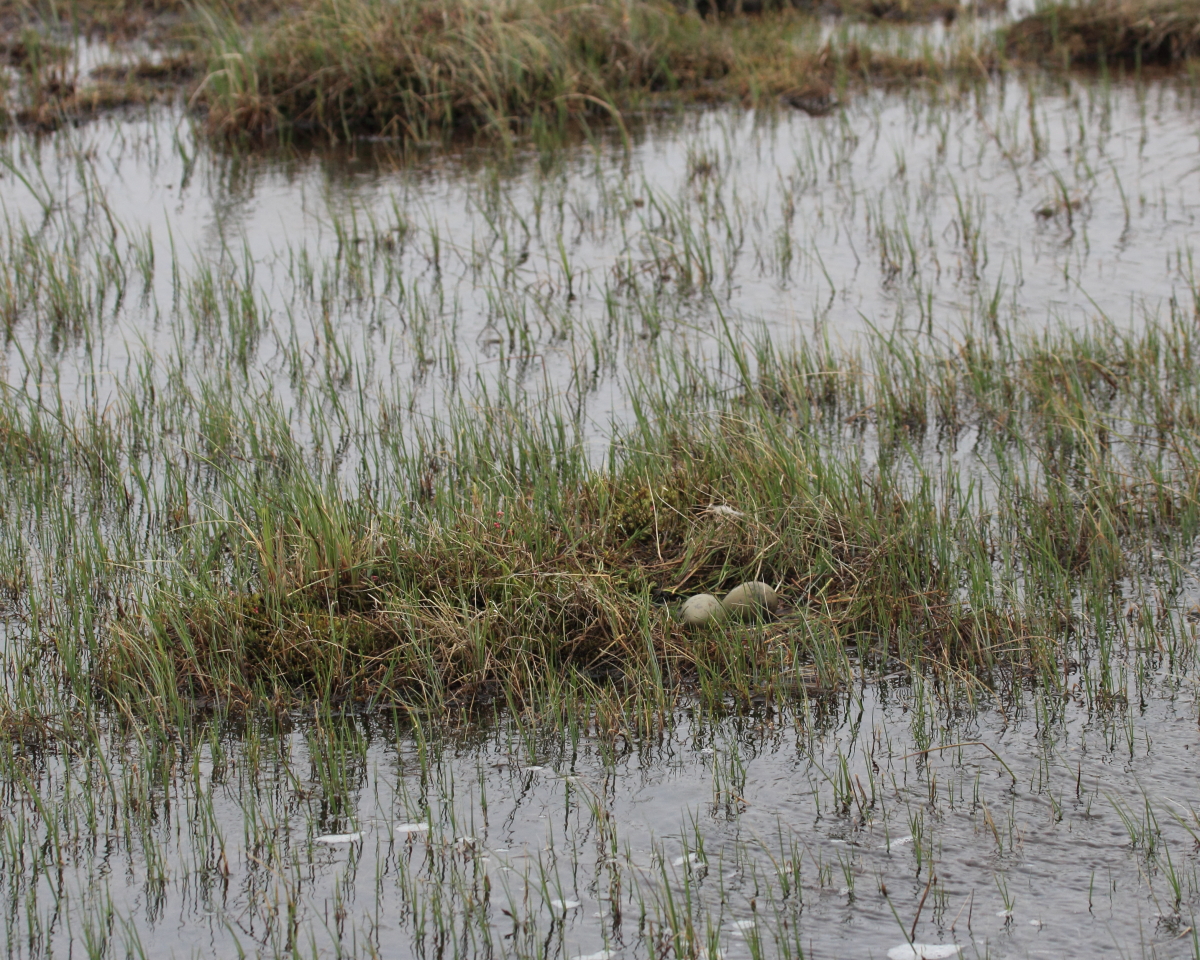
Willow Ptarmigan nests!
Anyways, I'll let some photos and video speak for themselves....
Smith's Longspurs were around on the bigger ridges.
Ice was still right to shore when we arrived
White-rumped Sandpipers were still moving through when we arrived
Molt migrant Snow Geese
Caribou were seen basically everyday
Flame-tipped Lousewort
Parasitic Jaeger "nest"
Mama (or Papa?) both adults let us know we weren't welcome
Whimbrel on heath-lichen ridge with flowering Lapland Rosebay
American Golden-plover near nest
Arctic Fritillary, my only lifer butterfly
1 pair of Short-billed Dowitchers was present at the very south end of study area
Arctic Tern colony (18+ adults) at south end of study area
Long-tailed Duck on nest
Me at the coast near the end of the trip
Semipalmated Plover doing a half-hearted broken wing display
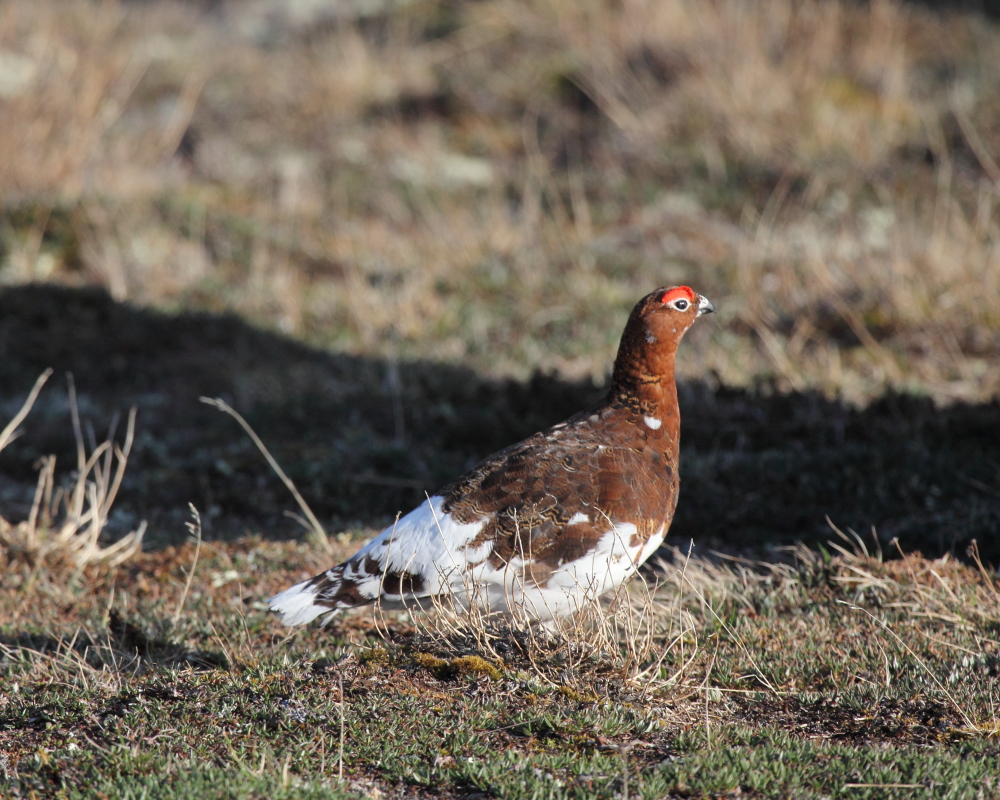
Female Willow Ptarmigan
Camp pond at midnight
Frosty Lapland Rosebay
Red-throated Loon on nest
Common Redpoll in birch. Redpolls were indeed common and I was pretty sure I heard Hoaries once or twice
Northwest end of Akimiski Island, Nunavut. Check out that ice in the background!
First look at the camp. Looking north.
Scared up a Compton's Tortoiseshell
First Willow Ptarmigan sighting....!
Hudsonian Godwit at camp pond. Hard frost that night froze a skim of ice on pond.
The White-crowned Sparrows we saw were quite variable. From pale-lored individuals like this to completely dark lores.
Painted Lady was probably the most common butterfly I saw