Well it might be safe to say that spring migration has finally arrived in southern Ontario bringing with it some nice rarities in the past week. I'm happy to say I got in on it today with a really nice Worm-eating Warbler! A fine selection of other birds this past week in Ontario:
That's a pretty nice week any way you slice it, and looking at the weather forecast it looks like the next week should be pretty good too, so what are you waiting for?
Well I got the info back on "my" collared Snow Geese already from the bird banding lab (check out my previous post for photos of the geese).
Bird number one (TR47):
Bird number two (TU72):
As I expected, both were captured and banded on the breeding grounds of Bylot Island. That's the same as the bird Ken and I found last spring. Here's a map to give you a sense of how far these birds still have to travel (remember it is still very much winter where they are going!):
A is where I found the geese, B is where they have to get too! Just 3000km to go...
I've been in easternmost Ontario all Easter weekend and took advantage of the annual Greater Snow Goose migration that passes through the area. On Friday while spending time at Erica's family sugar bush, we had a Golden Eagle fly right overhead. A few Golden Eagles seem to follow the huge number of geese into eastern Ontario every spring.
After seeing just a few small flocks of Snow Geese on Friday, I decided to head further east Saturday morning going to the Lancaster, Ontario area. My first stop was Westney Point on Lake St. Francis (the widening of the St. Lawrence River) - I was a bit dissapointed to only see about 2000 Snow Geese on the ice here, but pleasantly surprised to hear and then see a small flock of Cackling Geese in with a big flock of Canadas. I went a bit further east to Creg Quay Marina and found another 750 Snow Geese. Between those two spots on the Lake/River I also had a nice mix of ducks including lots of Northern Pintail.
I decided the geese must be out feeding in some fields, so I decided to head north through Lancaster towards where I had seen a big flock a couple springs ago. I wasn't dissapointed. Pretty soon I came across a flock of at least 10,000 Snow Geese in a corn field! What was even better was the birds were really close to the road allowing me to get lots of photos and video while sitting in my car:
After a little while of searching I picked out something different...a Greater White-fronted Goose! Seem to be seeing lots of them this year!
I kept searching and ended up with another couple of interesting geese, first this one that I am calling a Ross's:
See the Ross's Goose?? It's a pretty blurry shot...
And then this one which I think is likely a Ross's x Snow hybrid:
Hybrid Snow X Ross's Goose?
But that wasn't all this flock had to offer me! I soon found a neck-collared bird:
Collared Greater Snow Goose "TR47"
And going through my photos on the computer I found a second one:
Collared Greater Snow Goose "TU72"
I have submitted the information to the Bird Banding Lab and should hear in the next week or two where these birds were originally banded. Based on the information I received about a similarly-collared bird Ken and I found last year near Ithaca, NY I would bet these birds were banded on their breeding grounds on Bylot Island, Nunavut! I'll post an update once I know for sure! (UPDATE: got the info on both birds back, check here to read about it)
All in all I was happy to see lots of geese of 5 species, although unfortunately I couldn't find the Pink-footed Goose that was in upstate New York recently....
I recently received/calculated some of the most recent Ontario eBird stats, which many of you might find interesting. Most of these stats (unless mentioned otherwise) are as of the end of February 2013.
If you aren't using eBird yet, you might find this presentation I recently did helpful.
First up, the most interesting stat (in my opinion) is the number of checklists submitted per year. The growth of eBird in Ontario continues to be staggering:
Ontario eBird checklist submissions per year
And amazingly, we are already (as of March 29, 2013) up to 37,097 for this year! February and March 2013 have had the most checklist submissions yet! Viewing the same data, but per month reveals the not surprising trend through the year where birders are out most in spring and fall:
Ontario eBird checklist submissions per month
The geographic distribution of observations has stabilized a little bit now, with the only real surprises (in my opinion) being a) Northumberland at number 1 (although that is explained by about half of those are from the upload of the Northumberland County Bird Database); b) the relatively poor showing by Hamilton and Halton at spot 14 and 15; c) the strength of Peterborough; and d) the relatively poor showing by Middlesex at spot number 30. The full listing is in table 1:
Table 1. Total number of eBird observations submitted for each Ontario "county" all time, sorted from most to least observations.
County
observations
Northumberland
315022
Essex
281163
Toronto
241902
Ottawa
190418
Norfolk
187778
Durham
133205
Peterborough
112312
Waterloo
106083
Niagara
98309
Peel
92268
Frontenac
89222
Stormont, Dundas and Glengarry
88317
Leeds and Grenville
87101
Hamilton
68451
Halton
67575
Wellington
66281
Chatham-Kent
63487
Nipissing
60775
Elgin
60589
Haldimand
53290
Perth
50552
Cochrane
50208
Bruce
48034
Algoma
46072
Kawartha Lakes
44594
Lambton
43062
Lennox and Addington
42393
Prince Edward
41914
Thunder Bay
38495
Middlesex
33599
Simcoe
31504
Rainy River
29984
Kenora
25639
Prescott and Russell
20951
Muskoka
20510
York
20413
Renfrew
17695
Hastings
17181
Oxford
15823
Timiskaming
14852
Manitoulin
14731
Huron
12293
Lanark
10603
Parry Sound
8838
Grey
8355
Brant
8169
Haliburton
8040
Dufferin
7330
Sudbury
6599
Greater Sudbury
5847
The Ontario eBird user base also continues to grow. To date we have received checklists from an impressive 5985 different users! I have ranked everyone by the number of observations (each species/checklist combination counts as an observation) - if you want to know where you fit on that list or your total number of eBird observations let me know! Personally, I've submitted just shy of 83,000 observations!
One of my most recent eBird observations: the Western Grebe in Toronto
And finally, eBird has records of 679 species, forms, spuhs and slashes (read this article to understand what that means!) in the public database. The top 25 species reported are listed in Table 2:
Table 2: Top 25 species reported to eBird in Ontario.
I've given a few "Introduction to eBird" presentations over the last couple years and I got around to recording one in March. I've put it up on YouTube. You can watch it embedded or click on the video to open it in a new window. It is just over 45 minutes long:
On the weekend I was chasing a Snow Goose that had just flown over me with a flock of Canadas when I got sidetracked by some Wild Turkeys. You see, I came over the crest of a hill and saw the familiar sight of a flock of Wild Turkeys, except this time there was a big Tom strutting his stuff in all his glory. I pulled up parallel with him and parked my car and grabbed my camera. I got quite a show over the next 30 minutes!
I initially thought I captured some mating on video, but after reviewing it it just looks like the Tom is awkwardly balancing on the hen's back....not sure if this is foreplay or equivalent to spooning...what do you think? :)
On St. Patrick's Day Ken, my Dad and I led our annual swan/waterfowl/early spring migrants trip to Long Point with the Kitchener-Waterloo Field Naturalists Club. It was a very successful outing despite the sometimes wintery weather (in stark contrast to last year's shorts weather!). We managed 64 species for the day, which is about normal for the trip.
We always start the trip off at Aylmer Wildlife Management Area to have a look for Tundra Swans. This year, thanks in part to the late spring, there were still a few thousand swans to be had. From there we make a quick stop at the Aylmer Sewage Lagoons before heading east along the lake shore to Long Point. The ducks this year at Long Point were really good. There were about 10,000 ducks in the Inner Bay, mostly divers like Redhead, Scaup, and Canvasback. Besides the large numbers of diving ducks a nice bonus were the two Greater White-fronted Geese at Lee Browns:
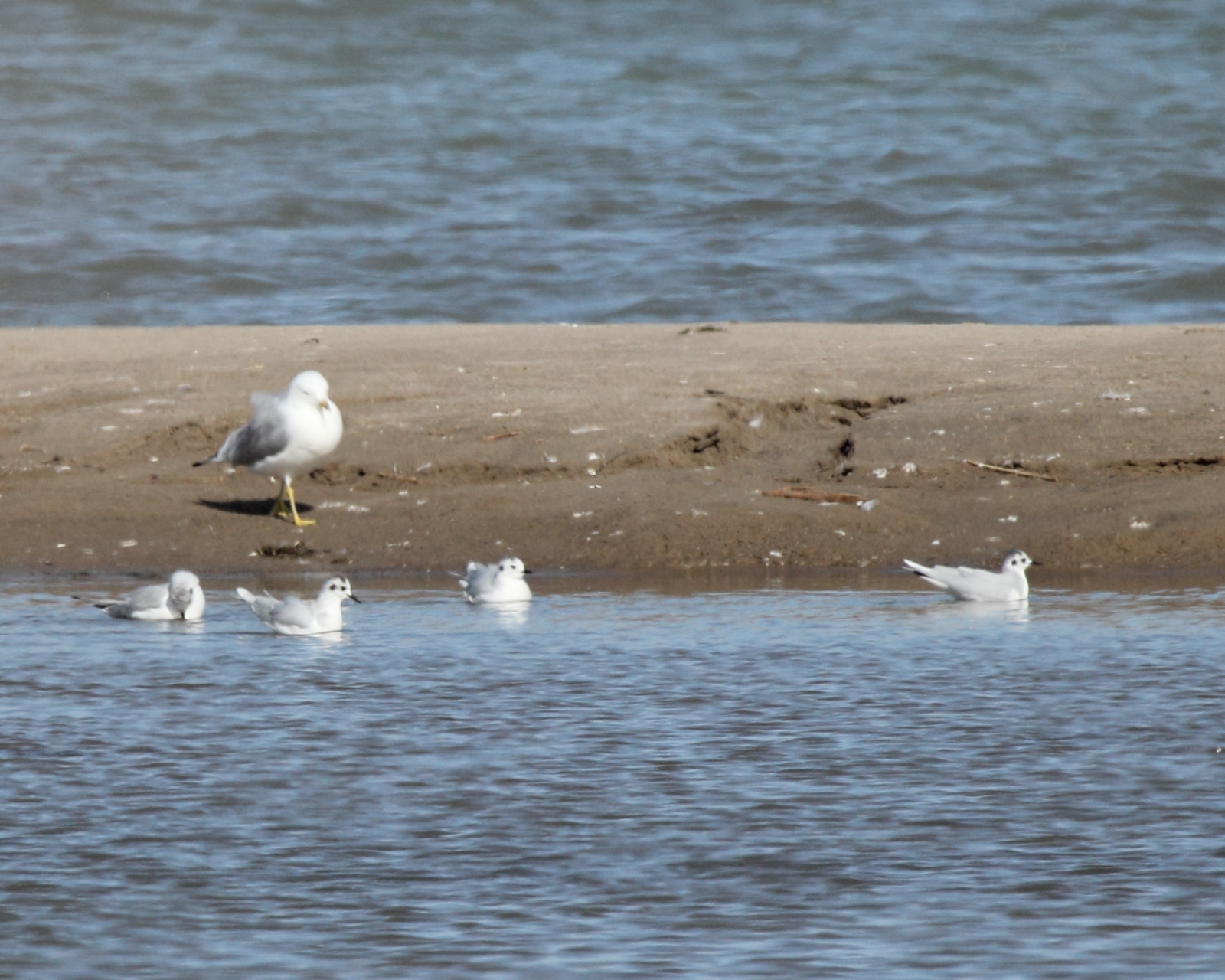
The Greater White-fronted Geese were a Long Point bird for me which made them extra nice. The real highlight of the day however was our last stop of the day at Turkey Point. Here, while scoping from the marina we saw some distant Little Gulls. We drove down closer and had great looks at at least 25 Little Gulls. The whole group enjoyed great looks at these birds as a nice way to finish the day.
Ontario birders often take Little Gulls for granted but we are pretty unique in North America to have such good numbers of these tiniest gulls in the world. Just check out the map on eBird or notice the fact that the ABA ranks them as rare or Code 3 on the ABA Checklist. I managed to snap quite a few photos of 3 ages:
An adult (left) and second basic (right)
First (left), adult (centre) and second (right) basic Little Gulls