Wednesday, 9 October 2013

Brown Booby...yeeaAA!

Well, if there's one thing birders love it is a good wild goose booby chase! This crazy bird was found on Monday afternoon by Jim Pawlicki at Erie Basin Marina on the New York side of the Niagara River. (This is at the south end of the Niagara River Corridor IBA so please report all of your observation to eBird!)  A few lucky people saw it later that day (including in Canadian waters). Yesterday (Tuesday) I was able to get to Fort Erie for first light but had to leave mid-morning. I was a little bummed (to say the least) when I found out that I missed it later on but that's how it goes.  Luckily I had a second shot this morning and the bird obliged by doing a flyby heading upriver past my viewing location - thanks to Steve Charbonneau for picking it up! Apparently it was Steve's 400th bird for Ontario! It wasn't close enough for photos (but was closer than the reef tower) so here is a shot I took in Cuba of an adult female:
adult female Brown Booby from Cuba in 2006
The best photos and video of the bird I have seen were on the Nemesis Bird blog - check it out...they even have video! UPDATE - Jim Pawlicki et al. got out on a boat on the afternoon of October 9 and he got some stunners!!

This bird has already made the news media too - check out this story from the St. Catharines Standardthis clip from CHCH news, and a story on The Buffalo News.

Anyways, I wanted to give some tips for those that might try for this bird later this week or this weekend.

Be prepared:
First, if you have a smart phone be sure you are subscribed to Ontbirds and Genessee Birds - that way you'll know if anyone is seeing it on either side of the river.  You can also just check the listings on the web for those - Ontbirds archives and Genessee Birds archives.  If you are an Ontario birder, you need to know that Canadian cell service is pretty poor along the river so be prepared for American signals - consider a prepaid voice/data package from you regular cell phone provider so you can use the American signal without paying more than your binoculars (alternatively you can just wait until your next bill and try to get them to remove the charges since you didn't leave the country).

If you are going to be there in the morning, polarized sunglasses will help cut the glare from the sun, which unfortunately you will have to deal with. Of course, you need a scope as the bird has been mostly on the far side of the river. It has been quite cool both mornings - I've been happy to have a winter hat and gloves for the first hour or so of the day.

Know the bird's routine
It looks like a pattern is developing for this bird. Between 7:30 and 8:30 it has been seen between the red-roofed building and the Peace Bridge before heading towards the lake and disappearing for a long period of time. I think this bird roosts somewhere in this vicinity, gets up and flies around for a bit then goes somewhere to feed.  Then it seems like it comes back mid-afternoon (after 2 pm) and spends a lot of time resting on Donnelly's Pier for most of the rest of the day. It seems like later in the day is more reliable, but you might be less likely to get the bird in Canadian water (if you care about that!).

Know where to look
So far, almost all of the observations in Ontario have come from a small parking lot at Mather Park across from Old Fort Erie. From there you can see several key landmarks (as summarized by Willie D'Anna here).
-Mather Park parking lot - Ontario birders are parking here and viewing from this general area
-Erie Basin Marina tower - This is where a lot of American birders are watching from.  You can easily see this tower (and see if birders in it are getting excited!) through your scope from the Ontario side.
-Donnelly's Pier - This is the spot where the booby seems most likely to come to rest in the afternoon.  It has a big sand/gravel deposit
-Reef Lighthouse - 42.881273, -78.915133 (not visible on Google).  This is the old frame of a building on a big rock reef where cormorants like to hang out. On October 8 the booby was sitting here at dusk. This structure is in American waters but it is only about 50 m east of the international border.
-Red-roofed building - 42.879589, -78.915133 (not visible on Google). This is also known as the water intake building.  It is a good reference point when searching.

Here is the map (click here to open in new window) showing those locations.


Update: here are some distance measurements:
Mather Park to Donnelly's Pier (NW tip) = 1.95 km
Mather Park to Reef Lighthouse = 1.41 km
Mather Park to Red-roof Building = 1.72 km
Mather Park to Erie Basin Marina tower = 2.79 km
Mather Park to international border = 0.96 km (shortest distance, which happens to be in a straight line towards Erie Basin Marina tower)

Erie Basin Marina tower to international border = 1.83 km (shortest distance, which happens to be in a straight line towards Mather Park)
Erie Basin Marina tower to Donnelly's Pier (NW tip) = 0.93 km
Erie Basin Marina tower to Reef Lighthouse = 2.08 km
Erie Basin Marina tower to Red-roof Building = 1.88 km

If you're interested, here is a screen shot of a bit better resolution map showing the Reef Lighthouse and the red-roofed building with the international border shown:
The reef lighthouse (upper left), red-roof building (lower right) and international border
You can explore that imagery on MNR's make a topographic map tool, just be sure to turn on the
southwestern Ontario imagery layer and set the transparency to about 75% to be able to see the structures and the border.

Wednesday, 2 October 2013

Where have you gone eBirding?

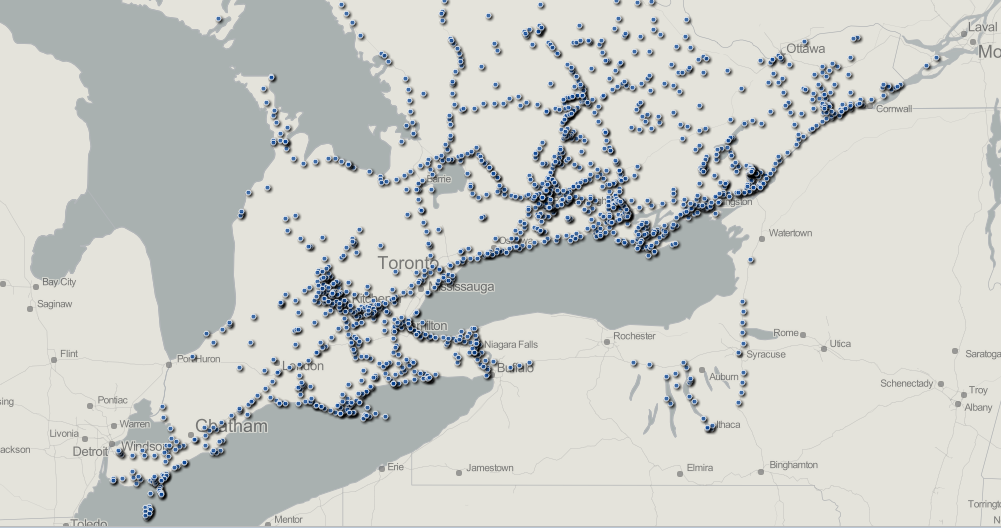
Alvan just posted his maps of eBird locations that he made using instructions provided on the Birdventure Blog, so I couldn't resist too!

It took me about 10 minutes or so and it is fun to see where all I have recorded birds in eBird.  You can go to my map by clicking here.

Anyways, here are some screen shots:
 

Looks like I still have lots of places to visit!

Here are detailed, step-by-step instructions:

Part 1: download your eBird data
1. sign in to eBird
2. click the "My eBird" tab
3. scroll down and click the "download my data" link from the right-hand margin (near the bottom)
4. wait ~5 minutes and you'll get an email with a link to download the data

Part 2: tweak it in Excel
1. open the csv file
2. select all of the data by clicking the corner between column A and row 1
3. click the data tab
4. click "remove duplicates"
5. click "unselect all" from the remove duplicates dialog box that opens
6. check the "my data has headers" checkbox
7. check the "submission ID" checkbox and then hit OK
8. delete all of the columns except location name, latitude, longitude and date
9. select all of the data as in step 2
10. in the data tab click sort
11. in the sort dialog box check the "my data has headers" then sort by the data column (A to Z should be default). This step doesn't really matter at all if you are just making the map...
12. in cell E1 type "checklists"
13. in cell E2 type "=Countif(A:A,A2)" (remove the quotes)
14. copy cell E2 and paste it into all of the other cells in column E (down to your last row)
15. copy column E by clicking the E at the top
16. right-click on E and click "paste special" and select values
17. go through steps 3-7 to remove duplicate locations
18. go through steps 9-11 to sort by checklist
19. now save the file as something in a location you will remember. be sure to keep it as a .csv file.

Part 3: map it 
go to geocommons.com and sign in/sign up
1. click "upload data"
2. scroll down and click "upload files from you computer"
3. click "add file"
4. find the file and add it
5. once you get the complete message, click "next"
6. click "next step" to georeference your data
7. click the "locate using the latitude and longitude columns" button
8. click the "continue" button
9. after a short wait to process the data you'll move to the next screen ("review your geodata") - click the "continue" button to move on
10. on the next screen you can give you data set a name and add a description (all optional). if you want your data (and map(s)) to be public be sure that "access" and "find" are checked off beside "everyone may:" under the heading "Who may access this data?" Alternatively if you don't want it to be public make sure those are not checked.  Once you're ready, scroll down and hit "save"
11. Now you should see your data on a map.  To make a map that you can edit, click the "Map Data" button
12. On your map screen (may take a few seconds to load all of your data) you will now have options in a "style" toolbar to edit what the symbols look like, plus you can edit your maps name.  Once you are done making your map pretty click the "save" button.
13. Once your map is saved you can just copy the url and share that with people (if you made it public), or you can click the "PrtSc" button on your keyboard to copy your screen view and paste that into a program like Paint.

There are a couple other, even simpler ways to make these maps! Thanks to Jeff Skevington for this one:
1. download your eBird data (as described in part 1, above).
2. delete all columns except latitude and longitude.
3. highlight all of the records (see part 2, step 2 above)
4. remove duplicates (see part 2, step 3-6 above)
5. copy all coordinates from the two columns
6. go to http://www.simplemappr.net/
7. create a login
8. paste the data into the point data tab
9. click on preview tab and refresh
10. position map and choose projection
11. click download and choose your preferred file type.

I think you can also now use the new Google Maps to do this- just save a spreadsheet with latitude and longitude and import it.

Thursday, 26 September 2013

Great Egret roost in Waterloo Region and the power of eBird

For the past two months Great Egrets have been roosting nightly at the Hespeler Mill Pond. On August 24, Ken, my Dad and I had the chance to meet up with (sort of) retired CWS researcher Chip Weseloh to try to make an accurate count of the number of individuals utilizing this roost. We weren't disappointed as we had at least 19 birds sitting out in the middle of the pond before sunrise.  Shortly after we arrived they started dispersing as is normal for these birds.
Part of the roosting flock

While this behaviour is quite common at this time of year for Great Egrets, it provides a really nice example of the utility of eBird to gather data to monitor such a roost.  This roost is especially well-suited to being monitored by Citizen Scientists because it is easy to observe and it is relatively close to a large population of birders.  In fact, since June of this year there have been at least 99 surveys done at Hespeler Mill Pond resulting in over 110 checklists being submitted to eBird!
A screen-shot showing recent Great Egret sightings at Hespeler Mill Pond
This is the really amazing thing about eBird - something as simple as going birding in your local neighbourhood can shed light on bigger questions.  In this example we can answer several:
1. When do Great Egrets start building in numbers at fall roosts?
2. When do Great Egret numbers peak at fall roosts?
3. How many individuals are using a particular roost?
4. Do numbers stay steady at a roost?

Obviously, there are many more questions that can be answered - these are just a taste. And when you think about the fact that millions of bird observations are submitted every month to eBird, the questions you can start answering are practically endless! And these are exactly the sorts of questions that scientists working for governments with increasingly fewer resources could never fully answer.

I'll leave you with this final figure showing all of the counts of Great Egrets from Hespeler Mill Pond by date for this year:

Great Egret counts from Hespeler Mill Pond on eBird

Chip Weseloh and Tyler Hoar recently published a paper where they used eBird to track the northbound migration of Great Egrets towards Ontario using eBird, I'll try to find a copy of that and post the link.

And if you aren't yet submitting your everyday bird records to eBird, hopefully this will convince you that it is more than worthwhile - every observation is a small piece of a huge puzzle!

Monday, 16 September 2013

Comet Darner from Brantford

Earlier this year, Bill Lamond found a few Comet Darners at a pond in Brantford. So one weekend back in July when I was back home Ken, Erica and I decided to check it and weren't disappointed.  The pond didn't look like much (it is a drainage pond less than 1/2 hectare in size in an industrial park), but it was absolutely teeming with dragonflies.  When we arrived there were hundreds of Black Saddlebags, Widow Skimmers, Twelve-spotted Skimmers and Familiar Bluets (amongst a few other species) but it didn't take us long to find our target:


Comet Darners are historically very rare in Ontario, typically being found only to our south. In fact, when the current Ontario Odonata Atlas species maps were done up in the early 2000s the map for Comet Darner had only 2 records on it! However, in the last several years we have seen an increasing number of records, still all from southern Ontario where migrants are more expected.  It is hard to know for sure whether the increase in records is real or just an artifact of the greatly increased search effort by the growing number of dragonfly enthusiasts in Ontario.  Realistically, it is probably a combination of those two factors.

The Brantford record is especially intriguing because Bill also found Comet Darner at this location last year, which may suggest that the species successfully overwintered at the site - something that hasn't been demonstrated yet for Ontario.  We did a quick search of the shoreline for exuviae but were unsuccessful in finding any.  Of course, with the abundance of other migrant species at the site, maybe it is just the perfect spot for migrant species to drop in to...

This species is similar to the familiar Common Green Darner, but the red abdomen is really distinct.  Another easy field mark is the patterning of the postfrons (think of it as the top of the 'nose') - on Common Green Darner there is a "bulls-eye" pattern, while Comet Darner is plain:
Top view of head and postfrons of Comet Darner
Top view of head and postfrons of Common Green Darner
If you are at all interested in Odonata in Ontario, be sure to check out the Ont-Odes google group and submit your sightings to the Ontario atlas (details here).  There is also a course being offered at Long Point Bird Observatory at the end of the month that you might be interested in!

Saturday, 14 September 2013

Gannet in The County!

I decided yesterday that I was overdue for a trip into "the county" as people around here like to call it. My first stop was Charwell Point, an amazing spot that Brandon showed me not long ago - it has a nice mix of habitats: a good duck/heron pond, a beach, and an area of big willows that attracts migrant passerines. It is also a small peninsula in Lake Ontario.

I was happy that I brought rubber boots; even with them I almost got wet crossing the "gull pond" that is in the middle of the point.  I suspect that because the water is so deep there this year, duck hunters weren't using the spot as frequently.  It was quiet for birds, so I decided to do a short lake watch at the end of the point.  I'm glad I did! After not seeing much I noticed a big white bird coming in from the east -  I put up my binoculars and was floored to see an adult Northern Gannet! I snapped a couple photos as it flew by. I pulled my scope off my tripod and set my camera on it to get a video of the bird once it had landed on water.  The bird continued further and further back to the east, where I eventually lost it.  The entire duration of this was 5 minutes (9:25 - 9:30 am).

Here are some pics and a video (you need to watch the video in HD otherwise you don't see much):


That was the highlight of the day, however, bird activity did pick up: I saw a couple nice flocks of warblers and I finished at Charwell Point with a decent 63 species.  See my complete eBird checklist.

Gannets, while common at breeding colonies (like Bonaventure Island) and elsewhere on the east coast are very rare here in Ontario, with usually only a few per year at best. Of those, the vast majority are first year birds that presumably wander up the St. Lawrence and eventually make it to Lake Ontario. In fact, prior to 2013 there were only 3 records of adult gannets accepted by the OBRC:

-May 13, 1983 at Prince Edward Point, Prince Edward County found by RKF Edwards
-November 24, 1990 at Moore Point, Durham Region found by Brian Henshaw
-October 23, 2012 at Netitishi Point, Cochrane District found by Josh Vandermeulen and Alan Wormington

The bird I saw is quite likely the same adult gannet that has been "stuck" on Lake Ontario for several months.  Here's the eBird map showing gannet sightings in the past year:

Adult gannet sightings from Lake Ontario in eBird since last fall
Those records, plus a couple not shown on this map that I knew of (please contact me if you know of others) are listed below in chronological order:

2012:
-September 1 at Hamlin Beach State Park, Monroe County, NY by Dave Tetlow
-October 13 at Gravelly Bay, Jefferson County, NY by Antony Shrimpton
-October 21 at Derby Hill, Oswego County, NY by Bill Purcell and Ken Burdick
2013:
-May 1 at Prequ'ile Provincial Park, Northumberland County, ON by Fred Helleiner
-May 7 and 18 at Hamlin Beach State Park, Monroe County, NY by Andrew Guthrie
-July 25 at Presqu'ile Provincial Park, Northumberland County, ON by Steve Oswald
-September 1 at Brandon's Condo, Hamilton, ON by Brandon Holden
-September 10 at Colonel Sam Smith Park, Toronto, ON by Garth Riley and David Pryor

Given the rarity of adults on Lake Ontario, there is a strong argument to be made that these all involve the same bird.

Thursday, 12 September 2013

eBird's hotspot explorer launched!

The eagerly (by some) anticipated public launch of eBird's latest data visualization tool happened today.  If you are at all interested in bird distribution or citizen science then you'll want to check it out!  Below you'll find a quick run-through of how I use the Hotspot Explorer. You should also read the excellent summary by Dick Cannings here.

To get to the Hotspot Explorer just go to eBird and then click the "explore data" tab and then click on the hotspot explorer link.

Once you get to the Hotspot Explorer you'll get a page that looks like this:

That's a grid showing species richness by colour (yellow = low, red = high). Remember, this is only as good as the data that goes into eBird, so it is far from complete, especially outside of North America. You can zoom in on particular areas, like North America or Ontario:

You can click on any one of the grid cells to bring up a species total - that's the total number of species reported to eBird for that grid cell. Zooming in further brings you to the hotspot view:

This view is also really cool because it shows you individual hotspots colour-coded for species richness.  So you can quickly find which spots you should check out!  You can also refine the date-range, so if you are interested in finding out which are the best spots in September you can do that, or maybe just for the past two months!

Clicking on an individual hotspot marker will bring up some quick info about that hotspot:

In the example above, the hotspot name is Hillman Marsh Conservation Area, it is found in Essex County (Ontario) and there are 291 species reported to eBird and 1057 checklists (not too bad!). There is also a link here to the Bar Chart, High Counts, and directions (a google map of the hotspot).  Pretty handy.

But the real fun starts by clicking the View Details button:

This gives you a complete list of species for that hotspot and details of the most recent record for each species.  You can sort this list taxonomically by clicking "species name" at the top of the list or you can sort by last record date by clicking the "last seen" at the top of the list.  You can bring up the complete eBird checklist by clicking the date of any record.  At any time we could change the output by date, too.  So if we wanted to see the details for this year only, or for the month of May only, it is only a matter of changing the date settings at the top of the screen.

In addition to the species list, there is more details on the right hand side of the screen:

This shows first the "Top eBirders", the top 10 eBird users based on species or checklists submitted (just click the button to toggle between the two).  This is where the real genius of eBird's deveolopers comes in...they know some birders just won't be able to resist this challenge of moving up "the rankings".  Have a look at your local hotspots - are you in the top 10? If not, this is the official firing of the starting gun!

Below the Top eBirders section is a list of recent visits - this is also very handy.  You can see who has been birding recently at this hotspot and how many species they saw - click the date and you'll be taken to the complete list of what they reported!

Anyways, I can attest that this is a really fun new tool, and highly addictive! Definitely give it a try (you don't have to be an eBird user) and see if you can move up the rankings on your local hotspot!
**************************
If you notice that a hotspot is missing, that means you should suggest it! Here's how to suggest a location as a hotspot:
1. If the location is already in your account, you just have to sign in to eBird, click "My eBird" then "Manage my locations" - find the location name in your list of locations and check the checkbox beside the location name.  Then, at the top of the screen there is a little dropdown menu - click that and select "suggest as hotspots", finally, click the "submit" button beside the dropdown and you are done.
2. If the location is not already in your account, you just have to sign in to eBird and go to submit a checklist. When choosing your location for the checklist use the "find it on a map" option and plot the new location on the map.  Give it a name and then check the "Suggest as a birding hotspot" checkbox before clicking the "Continue" button.  That's it - you can just stop entering your checklist now because the location has been created and submitted as a hotspot suggestion.

In both of those scenarios the hotspot has been submitted to the hotspot reviewer team.  It could take a couple days for them to approve it or they may contact you for more information.  This is how we avoid having things like people's yards made into hotspots (unless they really are!).

Friday, 30 August 2013

Hannah Bay shorebird surveys

I was stationed at Hannah Bay (specifically at East Point) with Ross Wood, Alvan Buckley and Barb Charlton for the first two weeks of August.  The shorebirds were great.  The weather and bugs weren't....anyways, here's the post I put onto Ontbirds, with a few photos added at the end.

This is the project's fifth report, for the period 31 July - 12 August 2013 from East Point on Hannah Bay, Ontario, on the south coast of James Bay. This camp is located in the heart of the East Point Important Bird Area.

The Hannah Bay crew consists of Ross Wood (volunteer), Mike Burrell (Bird Studies Canada), Barb Charlton (volunteer) and Alvan Buckley (volunteer). Final reports from Hannah Bay, Little Piskwamish Point and Longridge Point will be shared as soon as possible.

The Hannah Bay camp is 68 km east of Moosonee, Cochrane District. High counts during the period are given below.

Black-bellied Plover – 101 adults on August 10. No juveniles to date.

American Golden Plover – 2 adults on August 5 and 1 adult on August 8.

Semipalmated Plover  - 46 on August 2; the first juveniles arrived on August 7

Killdeer – 11 on August 9

Spotted Sandpiper – 4 on July 31. Only juveniles observed during the period.

Solitary Sandpiper – singles on 5 days.

Greater Yellowlegs – 554 on July 31. Juveniles were uncommon at the start of the period but had increased to about 30% by the end.

Lesser Yellowlegs – 395 on August 1. Juveniles represented about 25% of birds at the start of the period but increased to well over half by the end.

Whimbrel – 6 on August 6. This species was mostly just observed flying over the study area.

Hudsonian Godwit – 674 molting adults on August 11.  East Point appears to be an important stopover site for this species, as the 674 birds represents almost 1% of the global population of this species. Flagged birds were seen on 9 occasions and represented at least 3 individuals.  Based on flag colour, one of these flagged birds was banded in Canada and the other two were banded in Chile. On August 10 as the tide came in Ross Wood and Mike Burrell watched a flock of 27 individuals circle overhead gaining altitude for close to 30 minutes before eventually heading south, presumably leaving James Bay.

Marbled Godwit – 39 on August 3. Small numbers daily.

Ruddy Turnstone – 35 adults on August 2. The first juveniles arrived on August 6.

Red Knot – 42 birds in a flyover flock on August 9.  This species was very uncommon at East Point, with birds on the ground only on 3 days, including 2 juveniles on August 11.

Sanderling – 6 birds on August 4. Uncommon at East Point with low counts on 7 days only. No juveniles observed.

Semipalmated Sandpiper – 7311 on August 6. Juveniles represented a very small portion of birds (virtually none) when we arrived but had increased to over 50% by the end of the period. On August 10 as the tide came in Ross Wood and Mike Burrell watched several flocks totalling over 500 birds flying southeast at high altitude, presumably having fattened up enough to leave James Bay. On August 12 Ross Wood and Alvan Buckley found an adult Semipalmated Sandpiper with an engraved flag - based on the colour of the flag this bird was originally banded in Peru.

Least Sandpiper – 425 on July 31. Mostly juveniles at the beginning of the period, by the end there were only a handful of adults left.

White-rumped Sandpiper – 2760 on August 6. No juveniles yet.

Pectoral Sandpiper – 259 on August 10.  First juvenile on August 11. On August 10 as the tide came in Ross Wood and Mike Burrell watched a flock of 40 individuals circle overhead gaining altitude before heading south, presumably leaving James Bay.

Dunlin – 6 adults on August 3.  This species was very uncommon at East Point – only adults were observed and only on 6 days.

Stilt Sandpiper – 6 adults on August 1 and 3 adults on August 3. Always observed roosting at creek mouth at high tide with Short-billed Dowitchers and Hudsonian Godwits.

Buff-breasted Sandpiper – 4 on August 2 and 1 on August 3.

Short-billed Dowitcher (hendersoni) – 6 adults on August 3. Low numbers of adults on 7 days, always observed roosting at a creek mouth at high tide with Hudsonian Godwits.

Wilson’s Snipe – 14 on August 11.

Wilson’s Phalarope – 2 juveniles on August 5. Singles seen on August 3 (adult), 7 (juvenile) and 9 (unknown).

Red-necked Phalarope – 5 juveniles on August 12. Also seen on August 1 (1 adult), 2 (1 adult, 2 juveniles), 3 (1 adult), 8 (1 adult), 10 (2 adults) and 11 (1 juvenile).

OTHER BIRDS: Blue-winged Teal – female with 9 young near camp; Black Scoter – 300 on August 7; American White Pelican – 3 birds on August 12; Yellow Rail – single bird flushed on August 7; Sora – single bird heard calling on August 5; Little Gull – 1 adult on August 2; Black Tern – 1 molting adult on August 3; Arctic Tern – adults on 4 days; Bank Swallow – flock of 15 on August 7; Gray Catbird – single around camp irregularly through period; LeConte’s Sparrow – 1-3 still singing around camp; Nelson’s Sparrow – up to 29 singing males; Common Redpoll – flocks flying over daily

MAMMALS: Single Grey Wolf seen on August 4 and 6. Black Bears observed almost daily. 1 Snowshoe Hare on July 31. Deer Mouse observed almost daily in one of the cabins (I won’t reveal whose, but you can guess!). Woodland Caribou tracks on August 1. Moose tracks most days. Striped Skunk around camp on a few days; possibly depredated on the night of August 9. Red Squirrel! around camp on several days.

HERPTILES: Wood Frog, American Toad, Northern Leopard Frog, Spring Peeper, Eastern Gartersnake.

Butterflies: Least Skipper, Common Branded Skipper, Roadside Skipper (record late for Ontario), Bronze Copper, Bog Copper, Spring Azure, Atlantis Fritillary, Silver-bordered Fritillary, Arctic Fritillary, Northern Crescent, White Admiral, Viceroy, Common Ringlet

ODONATES: Northern Spreadwing, Emerald Spreadwing, Marsh Bluet, Eastern Forktail, Variable "Lineate" Darner, Lake Darner, Shadow Darner, Zigzag Darner, Four-spotted Skimmer, Crimson-ringed Whiteface, Black Meadowhawk, Cherry-faced Meadowhawk.

Check out Alvan’s blog for photos and a map of the Hannah Bay camp location. Mike Burrell also has some photos on his blog and Jean Iron has photos from the previous crew at this location

ACKNOWLEDGEMENTS: The Western James Bay Shorebird Survey is a cooperative effort spearheaded by the Canadian Wildlife Service, Royal Ontario Museum , Ontario Ministry of Natural Resources (OMNR), Bird Studies Canada and Moose Cree First Nation. Additional support for the 2013 expedition was provided by TD Friends of the Environment Foundation. The OMNR also provides helicopter transport to and from field camps and accommodations in the staff house while crews are in Moosonee. Thanks to Ken Abraham, Rod Brook, Sarah Hagey and Kim Bennett of OMNR for logistical support. Lastly, without the many hours of dedicated volunteer support, this project would not be possible.

Some photos:
Molting adult Bonaparte's Gull
Adult White-rumped Sandpiper
 
Juvenile Semipalmated Sandpiper
Adult Hudsonian Godwit

One of only a couple Red Knots seen

Adult Red-necked Phalarope

Flagged Hudsonian Godwit.  The red flag indicates it was banded in Chile.

Least Skipper
Silver-bordered Fritillary
 
Northern Spreadwing
Marsh Bluet


Fresh juvenile Bonaparte's Gull

Fresh juvenile Herring Gull

Black Bear munching on Sow Thistle
 I tried a panorama of the creek mouth that fed into "our" bay - the photo needs to be opened on your computer to properly view it, so you can download it by clicking here.  A preview is below, but because of the photo's dimensions it will not display properly: