Showing posts with label Hudsonian Godwit. Show all posts

Sunday, 11 October 2015

Unprecedented numbers of White-rumped Sandpipers in Southern Ontario

Unless you haven't been paying attention to any birding list serves, google groups or eBird reports in the past 10 days you'll know something special is happening in Southern Ontario right now with a couple of shorebird species.

It all got kick-started last Saturday when Michael Butler found a Eurasian Dotterel. This is such a crazy bird - just a handful of North American records outside of Alaska (something like 3 California, 1 Washington, 1 Oregon, and 1 British Columbia records). This was obviously pretty exciting but there has been some really interesting other sightings that may all have their origin in the incredibly strong winds we had for several days in a row for the first few days of the month.
An adult White-rumped Sandpiper in August on James Bay
The main species involved is White-rumped Sandpipers. These birds breed in the high arctic, and most of them stage on James Bay from August to October before heading south-east. With some birds being tagged in James Bay over the last few years we'll soon have a better idea if these birds stop on the US east coast or if they go non-stop out over the Atlantic to South America. Regardless, what we normally see in southern Ontario are small groups (1-10 individuals) passing through Ontario in late May/early June and then again from August to early November. Don't believe me? Here's the eBird line graph:
Frequency of eBird reports of White-rumped Sandpipers in s. ON
Above is the eBird frequency graph for White-rumped Sandpipers in southern Ontario. This shows you the percentage of checklist reporting this species for each monthly quarter. You can see the spring peak in the first week of June and the fall peak in late August. That gap in late September could be just a gap in sampling effort or, may represent the gap between when adults pass through and when juveniles start showing up (in most shorebird species the adults migrate first).
Average count of White-rumped Sandpipers in s. ON
In this next figure the average count is presented. In most cases, the count is in the range of 1-5 with the exception of the second week of October when it shoots up to 24. Again, this may be the difference between when adults (experienced migrators) and juveniles (less experienced) show up here.
A northbound White-rumped Sandpiper in June in Polar Bear PP

But this October has been anything but ordinary for reports of large flocks of juvenile White-rumped Sandpipers in southern Ontario. Check out this figure:
Reports by year of flocks of White-rumped Sandpiper of >10 birds
In the above figure, I have compiled the number of reports per year (and per decade for earlier years) of flocks of White-rumped Sandpiper that contained at least 10 birds. In the past five years, we have only had 7 reports. Prior to that (admittedly when eBird data is probably far from complete), we average just under 8 reports per decade. This, year, however we already have at least 24 reports, from an impressive 17 different census divisions (AKA counties)! That's pretty remarkable.

And it's not just the number of reports that is impressive. Below is a table of the ten highest counts I could find for southern Ontario (using the following data sources: Hamilton Naturalists' Club database, Northumberland County bird database, eBird, Ontario high counts database maintained by George Bryant, and the GTA and Ontario bird records database maintained by Roy Smith).

Count Date Observer Location, County
310 07/10/2015 Mike
V.A. Burrell
Exeter
Sewage Lagoons, Huron
200 14/10/2015 Dan Macneal Belwood Lake, Wellington
180 07/10/2015 Jarmo Jalava Wildwood Reservoir,
Oxford
135 11/10/2015 Mike
V.A. Burrell et al.
Mitchell Sewage Lagoons
(West Perth Wetlands), Perth
120 07/10/2015 Wayne Renaud Oliphant, Bruce
120 04/10/2015 Doug McRae Presqu'ile Provincial
Park, Northumberland
120 06/10/2015 Elena Kreuzberg Ottawa--Shirley's Bay,
Ottawa
118 04/10/2015 Jarmo Jalava Mitchell Sewage Lagoons
(West Perth Wetlands), Perth
100 10/10/2015 Mark Patry Ottawa--Shirley's Bay,
Ottawa
92 04/10/2011 Jeff Skevington Ottawa--Shirley's Bay,
Ottawa

Even if you take out some of the records that are likely the same flock on subsequent days 9 of the top 10 high counts in southern Ontario are from the last 10 days, so it is very apparent that this October really is amazing for this species here. We can speculate that these numbers have resulted from a grounding of the flocks of juvenile White-rumped Sandpipers migrating out of James Bay; maybe it was that incredible wind we had to start the month?
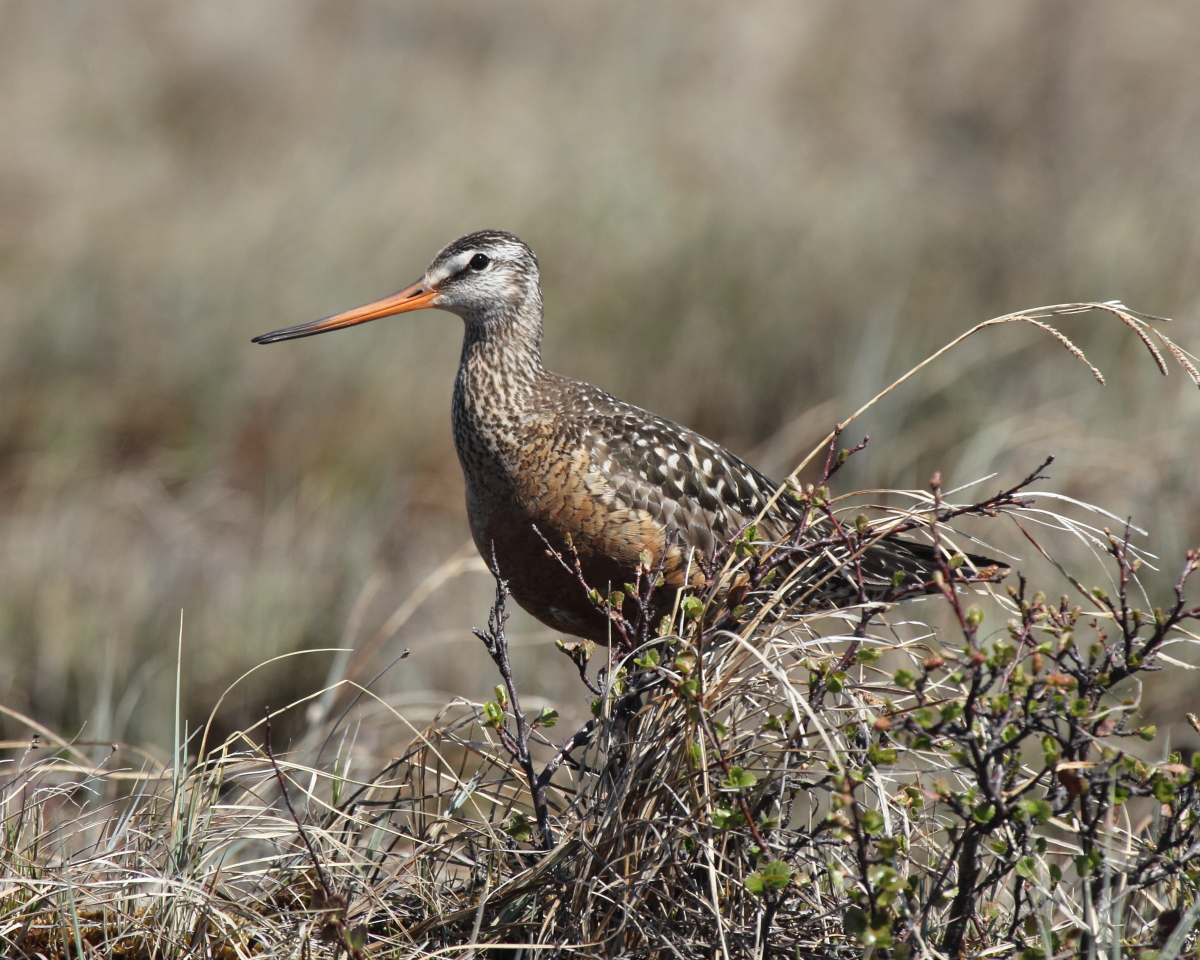
A Hudsonian Godwit on the breeding grounds in Polar Bear PP
A similar, situation has been unfolding over this same time period with Hudsonian Godwits, which have a similar fall migration route/strategy as White-rumped Sandpipers. There have been many reports across southern Ontario during this time so perhaps they have been impacted by the same weather phenomenon as the White-rumpeds, but I'll save that analysis for someone else!

What I really love about this is it really shows the utility of using eBird to monitor and analyse bird events as they are unfolding - you don't have to wait a year until the seasonal summaries in North American Birds comes out!

Sunday, 9 September 2012

James Bay highlights

Well, I finally got around to getting all of my photos and videos processed so I can present you with the much anticipated James Bay report, Chickney edition!  I was lucky enough to be part of the crew doing some of the shorebird surveys on James Bay as part of an ongoing joint MNR/CWS/ROM project monitoring Red Knots and other shorebirds utilizing the massive mudflats of western James Bay during fall migration.

We took off from southern Ontario on July 28, spent the day driving to Cochrane, then stayed the night before boarding the train on July 29 to Moosonee.  We started the trip out great with a singing Wilson's Warbler on Barb Charlton's yard in Flamborough of all place.  Next up were Le Conte's Sparrows and Black-billed Cuckoos singing behind our hotel in Cochrane!

On July 30 some of the crew got up early to check the Moosonee Sewage Lagoons out - wasn't too much but here is the eBird checklist. Logistics didn't quite work out so I spent an extra night in Moosonee before being helicoptered to Chickney Point where I would be stationed.  Ken, Jeanette Goulet (CWS) and I arrived at Chickney at about 9:30 AM where we exchanged places with Ron Ridout (BSC), Stu Mackenzie (BSC) and Don Sutherland (MNR).  Our fourth and fearless leader was Christian Friis (CWS).  We spent the next two weeks getting out to the coast for the daily flyby at high tide.  Numbers of shorebirds were absolutely mental with our daily average somewhere around 60,000 and topping out at over 100,000 individuals!!

View of the camp from the air, looking north.  Note the sweeeet observation tower!

Common Redpolls were, well, common

Juvenile Northern Shrike visited us once at camp

An obliging Alder Flycatcher

Crazy storm rolling in

That's hail!

Ice for drinks!

Nelson's Sparrow

The crew out on the flats

Amongst the amazing numbers of shorebirds were lots of Hudsonian Godwits.  This is a flock of about 2500!

Part of the same flock of Hudsonian Godwits - let me know if you find the black-tailed...

Marbled Godwits had mostly left by the time we arrived

A typical view of the shorebirds at Chickney

An even more typical view...what's your count?

Rusty Tussock Moth caterpillar

We had bats at dusk on a few occasions...consensus is that they were probably Hoary Bats
 
Snow Goose numbers built from a few hundred to about 10,000 when we left

A banded female (note the brood patch) Snow Goose

Peregrine Falcons and Merlins were regularly hunting the flats

Nicely coloured "Hudson Bay" Toad

Dawn flyovers were common - this one is a quiz bird for you!

View from the helicopter towards the coast - the trail through the Meadow of Doom

Big Snow Goose flocks at Chickney Channel
As you can see it was an action-packed trip with just so many birds it is hard to describe.  Our camp was located about 20km north of the Albany River.  Be sure to check out Ken's and Josh's blogs and Jean Iron's report for details on their similar trips.

I'll post an update once the daily checklists are up on eBird, but I think we had a bit over 100 species in the two weeks we were there...