Showing posts with label Snowy Owl. Show all posts

Sunday, 20 September 2015

What do Long-tailed Jaegers eat in Ontario? A week full of surprises

It was a very exciting week for me with all sorts of pleasant surprises wherever I went.

To start things off, on Sunday, Ken, my Dad and I were headed down to Holiday Beach IBA for the annual Hawk Festival. We left Waterloo in the dark but hadn't even made it to the 401 when we had our first surprise of the day. Just as we were getting off Hwy 8 I noticed a raptor sitting on a light post. Without thinking much I said "hey there's a red-tail". But as I looked at the bird a bit longer I realized that's not what it was. I pulled onto the shoulder of the ramp and put my bins on it and was surprised to see this:

Yep, a Snowy Owl - on September 13! I think it is more likely that this is a lingering bird from the big irruption last winter rather than an early fall migrant. We don't expect them until November at the earliest. Last year there were a couple of lingering Snowy Owls in Hamilton and on Amherst Island through the summer, so it does happen but it sure is a surprise to see!

With our spirits high from our surprising find we continued towards Holiday Beach. Before arriving we knew we were in for a good hawk flight as the conditions were perfect (clear with a brisk NW wind) and we were already seeing Sharp-shinned Hawks flying over the fields we were passing. We weren't the only ones thinking the same thing as the turnout was excellent:


And here's what everyone was watching:
A kettle of Broad-winged Hawks
That's right, nice big kettles of Broad-winged Hawks. They really got going at about 11 am and were still going strong when we left at 2. In any given year 2-6% of the world population of Broad-winged Hawks funnels through Holiday Beach, and usually a big chunk of those birds pass through in a few key days. The day's tally was over 7000, or about .5% of the world population! Needless to say we weren't disappointed, or even that surprised since the conditions were perfect. What was a surprise though was a dark morph Broad-winged Hawk that we saw go over with a group of "normal" (light morph) broad-wings in the afternoon. That was my first ever and Ken's second.

Our highlight, however happened just before noon. I was waiting by the classroom to get organized for a presentation I was to give when Jeremy Bensette and Emma Buck came walking over. As we were chatting I looked up to see a line of broad-wings passing overhead through a gap in the trees. I lucked out because as I put my binoculars up I noticed a heavily marked, slightly larger, and longer wings buteo overhead - "I've got a Swainson's Hawk!". Jeremy got it right away and even snapped a couple photos. It was an Ontario bird for both of us. I phoned Ken since he was on the tower and I wanted to make sure they got the bird too - he answered the phone with "juvenile light or intermediate morph!" then hung up. Pretty sweet!

And we had one more surprise fly over that day from the tower:
American White Pelican

That was Sunday. Through the week I was busy with some great staff meetings at Bird Studies Canada's headquarters in Port Rowan. A Say's Phoebe was found near Rondeau but a chase was not in the cards for me.

But my biggest surprise came yesterday, when I was at Erica's childhood home for some birthday parties. I checked my email in the morning and saw that Parasitic Jaeger had been found feeding in a field just 10 minutes to the north. I filed the information away thinking I'd go have a look later in the day. My phone promptly died so I didn't think too much more about it. Then, Erica's brother texted her to say he had spotted a crowd of birders checking something out at the spot so Erica and I went for a drive. When we got there we found out that it was actually a Long-tailed Jaeger - much rarer, and probably a first county record. At first it was a bit distant but eventually it started flying around feeding around the field, sometimes flying within 5 metres of us. At one point it landed, caught and ate a worm about 10 metres away from us. Absolutely amazing views of a bird that I have only ever seen way out on Lake Ontario off of Hamilton.
Now that's a sweet yard bird!
Can't be too many shots of this species with a silo in the back


Yes, that's a worm!


Needless to say, before the week started if you had told me I'd see a Snowy Owl, Swainson's Hawk, dark morph Broad-winged Hawk, and a worm-eating Long-tailed Jaeger I would have asked you if you'd hit your head!

Saturday, 8 November 2014

Amherst Island delights

This morning Kyle Blaney and Brad Hamilton found an American Avocet in the Ducks Unlimited Pond on the Martin Edwards Reserve (Amherst Island) so when we got word of it we headed down for the ferry. Erica and I met up with Mark on the 11:30 ferry and started the 20 minute boat ride from Millhaven to Stella. The ferry crossing at this time of year is a great way to see Common Loons up close as we had 15 on the way over and 14 on the way back (and you can get many more than that). They often are quite close to the ferry, offering great looks:

Once we got across it was straight to the Martin Edwards Reserve - this property is owned by the Kingston Field Naturalists and is known by many as simply the "KFN Property". It should be noted that, for liability reasons, you must be a member of the KFN, or accompanied by one, to enter the property. As soon as we got to the pond we could see our prize waiting for us, a beautiful American Avocet!

After enjoying very nice scope views of this bird we headed out further to the end of the reserve where we were able to pick up a nice assortment of ducks including a relatively rare for the area Black Scoter. Also present was a Snowy Owl, presumably the same bird that has been seen sporadically at least since late summer.

On the way out we kept moving to stay warm with the brisk south wind in our face but we did stop long enough to enjoy some Snow Buntings on the beach:


Friday, 29 November 2013

What a difference a year makes!

Last year at this time birders in southern Ontario were enjoying one of the biggest broad-scale irruptions of boreal birds we had seen for quite some time. The boreal forest had almost no food in the way of tree seed crops last year and so all of the birds that depend on those as food had to come south. That also included owls that had to move south in search of small mammal prey as their normal prey were in short supply (likely related to the poor tree seed crops).

Each fall, Ron Pittaway collects all sorts of information on  tree seed crops from a whole bunch of volunteers and puts together his now famous Winter Finch Forecast. And as usual, Ron has been pretty bang-on with his predictions this year (basically no real flight). That didn't surprise me, but what has surprised me has been just how few finches have come south. Much of this blog post is credited towards the information that is always contained in Ron's forecasts - if you haven't read the latest report I highly recommend it.

In this post I wanted to compare just how big of a difference a year can make with these birds, drawing on the instantly accessible (and free!) outputs of eBird.

Red-breasted Nuthatch
Red-breasted Nuthatches rely heavily on White Spruce cone crops. In a nutshell (pun intended!) when there aren't many spruce cones to feed on, they come south.

Here's an eBird frequency chart comparing the last two falls (August-November):
You can see that Red-breasted Nuthatches have been recorded on almost 50% fewer checklists in Ontario this fall compared to last year!

Bohemian Waxwing
Bohemian Waxwings feed mostly on Mountain Ash and other berries during the winter. According to the Winter Finch Forecast "mountain‐ash berry crops are very good to bumper from Alaska to Newfoundland and Labrador" so that means these birds have no reason to wander south.

Here's an eBird frequency chart comparing the last two falls (October-November).

The difference here is even more striking than with Red-breasted Nuthatch - last year at this time you were 16 times more likely to see a Bohemian Waxwing in Ontario!

And here's a map showing November sightings from this year and last year:
Orange = 2013, Blue = 2012


Pine Grosbeak
Like Bohemian Waxwings, Pine Grosbeaks are tied to Mountain Ash berries, so it isn't too surprising to see the similarity in the eBird results.

 Here's an eBird frequency chart comparing the last two falls (October-November).
That's not quite as extreme as Bohemian Waxwing, but at their peak during the third week of November last year Pine Grosbeaks were being reported on almost 14 times the frequency of checklist compared to the same period this year.

The eBird map for November Pine Grosbeaks is also similar to Bohemian Waxwing:
Orange = 2013, Blue = 2012

Purple Finch
According to Ron Tozer, Purple Finches are the wimpiest of the winter finches, only staying north when there is so much food that nothing could possibly go wrong.

The eBird frequency chart comparing the last two falls is interesting:

In 2012 we saw the normal spike in September and October as birds left but not so much this year. By the end of November in 2013 we are now more likely to find a Purple Finch in Ontario then the same time last year, suggesting there are more Purple Finches staying put in Ontario for the winter - this will be an interesting one to watch through the course of the winter.
Purple Finch near Bancroft
Red Crossbill
Ok, I'm starting to get lazy...here's the November eBird map:
Orange = 2013, Blue = 2012

White-winged Crossbill
And again, the November eBird map:
Orange = 2013, Blue = 2012

Common Redpoll
Redpolls are virtually non-existant (like most of the other finches!) this year in southern Ontario.

Here's the eBird frequency graph for the fall (October-November)"
Looking at that peak during the third week of November, last year you were almost 19 times more likely to encounter a Common Redpoll during that week compared to this year!

And here's the November eBird map:
Orange = 2013, Blue = 2012

Pine Siskin
I'm probably beginning to sound like a broken record, but the trend continues...

Here's the fall eBird graph (September to November:
At peak migration during the last week of October you were 45 times more likely to see a Pine Siskin in 2012 compared to the same time in 2013!!!

And here's the November eBird map:
Orange = 2013, Blue = 2012

Evening Grosbeak in Algonquin Park
Evening Grosbeak
Last year was a huge year for this species while this year is back to the recent average.

Here's the eBird frequency graph for the fall (October-November):
 
That peak during the first week of November was 19 times higher in 2012 than in 2013!

And here's the November eBird map:
Orange = 2013, Blue = 2012
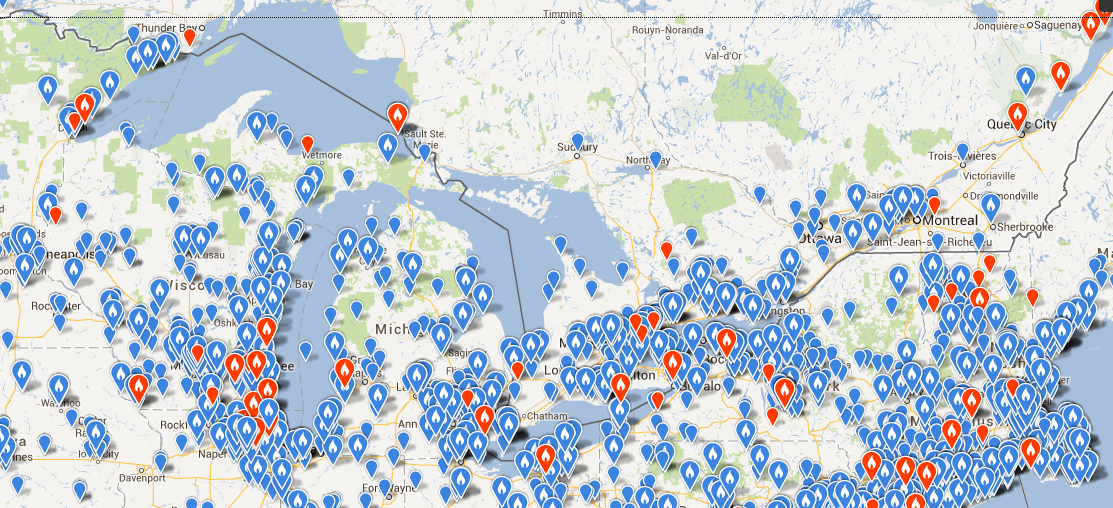
And of course it's not just finches that are irruptive from year to year. Check out this map comparing this November to last November for Snowy Owls - last year the west had a big flight and it looks like it is the east's turn this year:
Orange = 2013, Blue = 2012
Snowy Owl on Wolfe Island

I think there are some neat messages here. First it is amazing how we can tie in things like tree seed crops, small mammal populations and bird irruptions. It's equally impressive the amount of information that comes in every day to eBird by thousands of volunteers to help us better understand bird distribution and abundance patterns - even a couple years ago you wouldn't have been able to get such a clear, continent-wide picture of what was happening as it happens.