Showing posts with label Frontenac County. Show all posts

Wednesday, 22 July 2015

mmmmMantidflies again!

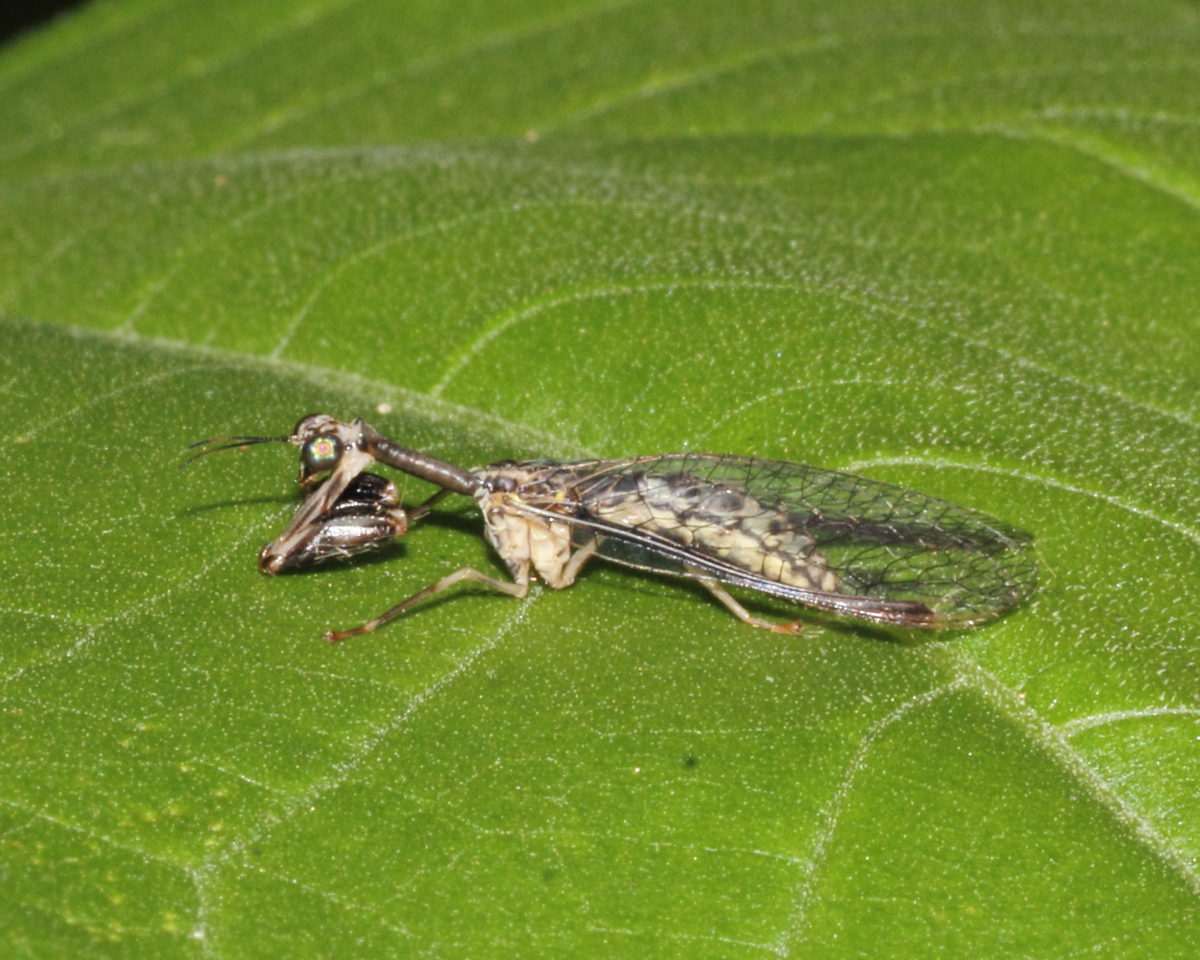
Last summer I was really excited to find a Mantidfly at my moth light. I wrote up a pretty thorough summary about that observation including some information about Mantidflies in Canada and the identification of that beast so check it out for some background.

Anyways, fast forward to a couple of nights ago and sure enough, there was another mantidfly waiting for me! This one looks like the same species as last year but I managed a bit better images:


Anyways, as I said, this is the same species as last year - Dicromantispa sayi, a species formerly only known from the Carolinian zone of southwestern Ontario, but there was a 2013 record from Tweed (Hastings County) and now my two from my yard in Frontenac County. With the moths I have been catching here I have really noticed a lot of species I am getting are mostly restricted to the Carolinian Zone plus the Kingston area so it isn't too surprising I guess to see the same with other insect groups.

I took a short video of this specimen too:

Anyways, they're such cool-looking creatures, not to mention their bad-ass life history that it is exciting to find them! If you're not convinced read my post from last year.

Monday, 13 April 2015

Kingston Lark Sparrow

On this warm spring evening Erica and I were pulling in to our local mini putt establishment when I got a text message from Mark Read that read "Just found a Lark Sparrow at Lemoine Point.". Yep, he didn't even include an exclamation mark. So, with less than an hour of daylight left, we headed for Lemoine Point.

As we arrived we could see Mark and fellow Kingston birder James Barber up ahead on the path, faithfully keeping an eye on the prize:

So there it was. We all enjoyed this rare bird from the mid-west before it eventually flew into some nearby pines to hopefully spend the night.

As mentioned above, Lark Sparrow is primarily a bird of the central US, regularly reaching into Canada in southern BC and the southern prairies. It is also rare but regular in southern Ontario with up to about 5 records per year. It is a species that could be expected here more often in years of extreme drought in the core of its range, like this year. This must be one of the earliest spring arrivals of this species in Ontario - the only earlier date I could find was one on 10 April 2010 from Pelee Island - most records fall in late April or early May.

The great thing about seeing this bird was that it meant two rare birds in Frontenac County in two days after Mark and I found this wayward White-crowned Pigeon on Wolfe Island yesterday. 


Wednesday, 2 April 2014

Will the winter ever end? The first week of April

It's finally starting to feel more like spring every day, though slowly. But if you check the weather as frequently as I do or you're reading Brandon's weather bird blog you'll know that we're still going to be getting at best seasonal temperatures for the next while. I'm OK with seasonal temperatures at this point.

Thankfully, the worst is likely behind us and we are into April. The birds that will arrive over the next 3-4 weeks are a bit less dependent on weather than March migrants, so we'll probably stay pretty much "on schedule" from here on out, despite cooler weather.

Personally, I had a great start to April with a big movement of birds all day going past my office window. Check out my eBird checklist from the morning - I tried my best to work but almost 10,000 Canada Geese going by is a bit of a distraction! I've got my yard list up over 50 species now with my first Tree Swallow this morning.
10,000+ Canadas and 152 Snow Geese passed by on April 1

Two Snow Geese right over my house!
This is 1 of 2 (the ugly one) Red-shouldered Hawks from 1 April
I had a meeting in Prince Edward County yesterday evening so on the way made a quick stop at Kaiser X-Road. This place is great all spring because there is a big flooded field that attracts waterfowl and later on shorebirds and Little and Bonaparte's Gulls. It was still mostly ice covered but there were loads of waterfowl including Snow Goose and Tundra Swan. Here's the full list.

Anyways what do we have to look forward to arriving this week? Lots! Many of these species have already begun arriving in the extreme SW part of the province (and beyond) so keep an eye out for them this week:
01 April -  
Bonaparte's Gull
02 April -  
Double-crested Cormorant
Tree Swallow
03 April -  
Great Egret
Yellow-bellied Sapsucker
Field Sparrow
Vesper Sparrow
04 April -  
Osprey
06 April -  
Common Loon
Sharp-shinned Hawk
Greater Yellowlegs
07 April -  
Cooper's Hawk
Hermit Thrush
Osprey on nest
One of my favourite signs of springs is when Ospreys show up back on nests. They are always really amazing because it seems like one day there are none and then the next day all of a sudden almost every nest  is occupied.

Wednesday, 4 December 2013

Thick-billed Murre in Kingston

Yesterday afternoon Janice Grant found a Thick-billed Murre on the Kingston waterfront. She called Mark Read who was able to confirm it as a Thick-billed Murre, follow it as it swam east along the lake shore and get a few local birders on it (side note, in two weeks Erica and I will become local birders in Kingston!). Mark posted to Ontbirds late in the day and not surprisingly many birders made plans to be there for first light.

I wasn't one of them because I had a meeting in the morning (which was cancelled due to the weather) but once the freezing rain cleared I made it out to try my luck before working the rest of the day from a local library.  Initially when we arrived my heart dropped a bit because there were only two birders present and all I saw were a couple of Common Loons in the harbour. However, a couple seconds later and I realized I was looking too far away - the bird was only about 20ft from the birders!

Needless to say, great views of this rare bird

I even took a short video - Erica's commentary sums it up:

Apparently, Thick-billed Murre used to occur semi-regularly on Lake Ontario in late fall/early winter but that hasn't been the case since the 1950s

The Birds of Hamilton by Bob Curry has a good summary of Thick-billed Murre in Ontario listing records from about a dozen years before the mid 1950s, some with fairly extensive "wrecks" of multiple birds.

[EDIT: Thanks to Glenn Coady for the following references if you are interested in Thick-billed Murre history:
Fleming, J.H. 1907. The unusual migration of Brunnich's Murre (Uria lomvia) in eastern North America. Proceedings of the IV International Ornithological Congress, pp. 528-543.

Hoyes Lloyd's review of the Birds of Ottawa:
Lloyd, H. 1923. The birds of Ottawa, 1923. Canadian Field-Naturalist 37: 101-115; 125-127; 151-156.
Lloyd, H. 1924. The birds of Ottawa, 1923 [conclusion]. Canadian Field-Naturalist 38: 10-16
Lloyd, H. 1944. The birds of Ottawa, 1944. Canadian Field Naturalist 58: 143-175.]


However, since then there have only been two documented records for Ontario:
1995: 5-6 December, Deschenes Rapids, Ottawa River, Ottawa. Found by Bruce Di Labio
1998: 29 November, Burlington Ship Canal, Hamilton. Found by Robert M. Sachs, Sheila Bowslaugh, Eleanor Sachs, and Carl J. Rothfels


The Ottawa record apparently was originally identified as a Razorbill (pretty easy to do when it isn't at your feet!) and it wasn't realized what it was until the morning of December 6. Since many birders already had Razorbill on their Ontario lists many missed out on this bird even though it was technically chase-able. Even relatively local birders missed this bird for that reason because there was only a couple hours between when its real identity was realized and the time it disappeared [edit - according to an anonymous comment it was killed by a Gyrfalcon!!].

Wednesday, 15 May 2013

Good things come in small flocks of White-crowned Sparrows

The birding in southern Ontario since mid-April has been great, to say the least with a long list of rarities having shown up.  I've been lucky enough to connect with more than my fair share and I have been very happy for that.  The last two have had something in common - they were both associating with flocks of White-crowned Sparrows.
White-crowned Sparrow in Polar Bear Provincial Park last summer

The first of these rarities was a young male Blue Grosbeak on Pelee Island.  It was found during the Pelee Island bird race (AKA Botham Cup) by Paul Carter.  Unfortunately, Paul wasn't on a team and though he waited for one of the 7 teams to pass him, none did, so no teams got it for the tally.  Most of them (including us) headed to there right after the race ended at noon on Saturday and got looks at this bird.  It was pretty elusive, alternating between the thick hedgerow and the grassy field that was just high enough to hide the bird.  It stuck around until at least May 13 (3 days) and on May 12 I got a few "record" shots of this bird:


This was a really nice bird to get and it was only my second ever (the first was a female I found at the Tip of Long Point on May 6, 2004). I think the photos of the more recent Blue Grosbeak might be a bit better....

The next nice bird to get was today. I was headed into Prince Edward County to check out some spots when I saw the post on Ontbirds advising that a Lark Bunting had been found by Mark Saunders at his home near Sharbot Lake.  I decided to do some birding in the county first, then head north.  I got on site a little after 1pm and I was greeted by Mark himself.  He told me the story about how he heard this strange song that reminded him of a mockingbird at 5am and when he went outside to investigate it turned out to be a Lark Bunting.  Amazingly, Mark had a Lark Sparrow at the same spot a couple years ago.  His farm is small but it is one of the only open field habitats in a sea of Canadian Shield forest for many kilometres in each direction.

Anyways, back to the bird.  The Lark Bunting was hanging out in a fairly small area near the actual house, usually with White-crowned Sparrows and after about 1 or 2 minutes of Mark telling me the story and showing me some of the places it had been seen the bird popped up and flew in front of me!  Obviously, it is a pretty distinctive bird with those big 'ol white wing patches and I got my camera out right away.  I managed a few shots and even one video of it. Overall I was a bit surprised at how small it was (certainly no bigger than the White-crowned Sparrows it was with), expecting something a bit bigger but that didn't bother me!


For some reason Blogger isn't letting me embed my YouTube video, so here's the link:
http://youtu.be/kaqIEzjwXfw

Well, it goes to show you, it is definitely worth checking through those flocks of common birds!