Showing posts with label mega rarity. Show all posts

Tuesday, 9 June 2015

A little twitch

Last Tuesday (2 June), Ben Di Labio found a Little Egret along the Carp River outside of the town of Carp. Birders arrived quickly from nearby and most local birders go to enjoy the bird until just before dusk when it flew north. It was seen again first thing on the morning of 3 June before flying west along the Carp River.

Little Egret is an old world heron that has colonized some of the Lesser Antilles and is showing up more frequently on the northeast coast of North America. Even though it is increasing it is still VERY rare in North America (an ABA code 4) and this will be a new species for Ontario, bringing the list to 491 assuming the OBRC accepts the report.

Unfortunately, at the time, I was working down at Long Point. Normally I would have been 1.5 hours away from this location (probably more like 1 hour for such a rare bird :)) but instead I was more like 6 hours so a trip was out of the question. The earliest I could try would be the next Monday (8 June).

There was no word on the bird for several days so it appeared the bird was gone, until a report on Sunday (7 June) afternoon from Mike Norkum, some 14 km southeast from Carp. It was reported again briefly on the morning of 8 June at this same location (but there were several reports that turned out to be Great Egrets) and finally it was pinned down at a small pond in the Carp River floodplain in Kanata (10 km from the first sighting).  I hit the road, picked up Mike Runtz on my way, and a little over an hour later was enjoying fine views of this sweet bird!
First look with a Great Egret for size comparison
Check out those yellow feet and blue lores
A good shot showing chest plumes
One more!
The Little Egret spent its time feeding actively while we were watching it, mostly stalking prey (it caught many small fish as we watched), but we also observed it regularly stirring the water with its feet. This behaviour is well-known, particularly by foraging Snowy and Little Egrets and may take advantage of the brightly-coloured feet/toes to either scare up or attract potential prey. Check out this paper from 1959 to read more about it. Or, you can check out the video I took to see for yourself:
Identification of Little Egret from the North/South American Snowy Egret can be tricky but the presence of two long head plumes, blue-grey lores, long, distinct breast plumes and a few other features all help seal the deal for this bird as Little Egret. David Sibley has a good page on these identifying features and there is a great ID essay here.

The history of this species in the Americas is very interesting - it first appeared in Barbados in 1954 when found by James Bond and was first documented nesting there in 1994. For a full history and overview of the species in the Caribbean, check out this article on eBird Caribbean. And if you still want more background information on this species, check out the species account on the IUCN's Heron Conservation website.

Here's hoping it gets found again for more people to enjoy!

Tuesday, 26 August 2014

White Ibis in Napanee!

This morning I got a text message from Mark Read, who collects bird sightings for the Kingston Study Area on behalf of the Kingston Field Naturalists. It had details that a juvenile White Ibis had been seen in Napanee. Re-reading the text now it alludes to the fact that I was expected to already have known about this bird and once I got home and checked the Ontbirds archive I see why - Terry Sprague had reported the details first thing this morning. For some reason his Ontbirds post never made it to my inbox (and not even into my spam folder...strange, but luckily Mark sent me the text...).

Anyways, I jumped in my car and made it to the spot where it had been reported and there it was!
juvenile White Ibis in Napanee, Lennox and Addington
Here's my post to Ontbirds:
Jeff Haffner found a young White Ibis this morning at 7 am in Napanee. I arrived at 935 and found it in roughly the same location. However, while I had my glasses off trying to get a phonescoped photo it disappeared. I didn't see it move but when I couldnt find it in my scope and put my glasses on I couldn't see it. I wasn't looking down for long so I don't think it flew but rather walked around a bend in the creek and out of sight. I did manage a couple photos that I will post on my blog when I get home.
Directions. Get off the 401 at exit 579 and go south to Jim Kimmet blvd and turn right (west). Just before the Wal-mart there is a bridge over the creek. Park before the bridge but be sure not to block the fire hydrant. The bird was north of the bridge in the creek before the bend.
Will post if I can refind it.
I should clarify that it wasn't Jeff Haffner who originally found it. Apparently (according to Terry Sprague) it was Robert Lane who found it on SUNDAY (24 August). I'm kind of glad that I didn't see Terry's post though since it sounded from his message like the bird had disappeared and I might have waited until someone re-found it.

White Ibis is a really great bird in Ontario, with just five previous records accepted by the Ontario Bird Records Committee. And of those, only one of them stayed in one place for more than a day. Here are the previous records as published by the OBRC:

  1. 1, juvenal, 27 September 1970, Point Pelee National Park, Essex. Found by Joseph P. Kleiman, T. Dennis Coskren, Dennis F. Rupert, Alfred H. Rider, Jeffrey A. Greenhouse, William W. Smith, Norm Chesterfield, Ray Knight
  2. 1, second-year, 12-30 (but only seen 12-14 and 29-30) October 1990, Turkey Point, Norfolk. Found by John Lamey
  3. 1, 27 June 1998, Pelee Island, Essex. Found by Ethan J. Meleg, David Hodare
  4. 1, juvenal, 3-6 October 2009, Whitby (3 October), Durham and Prince Edward Point (6 October), Prince Edward. Found by Harvey Gold, Daniel S. Kaczynski, Karl Jennewein
  5. 2, first alternate, 11 May 2012, Long Point (Old Cut), Norfolk. Found by Stuart A. Mackenzie, Fanny Senez-Gagnon

Anyone who has traveled to the US southeast knows that White Ibis are abundant there, so it's always a bit surprising to me that we don't get more of them here, especially given the propensity for northward post-breeding dispersal by herons in general. It seems likely that this bird made its way north on the same system in the last week or so that has brought at least 2 Snowy Egrets, a Eurasian Collared-Dove, a Violet-green Swallow, and an Ash-throated Flycatcher to southern Ontario (not to mention the Yellow-crowned Night-Heron that's still around). What else it lurking out there to find?

Here's my favourite shot of a White Ibis (this is an adult) from a trip to Florida several years ago. I'm still blown away by it!
White Ibis in Kissimee, Florida

Wednesday, 4 December 2013

Thick-billed Murre in Kingston

Yesterday afternoon Janice Grant found a Thick-billed Murre on the Kingston waterfront. She called Mark Read who was able to confirm it as a Thick-billed Murre, follow it as it swam east along the lake shore and get a few local birders on it (side note, in two weeks Erica and I will become local birders in Kingston!). Mark posted to Ontbirds late in the day and not surprisingly many birders made plans to be there for first light.

I wasn't one of them because I had a meeting in the morning (which was cancelled due to the weather) but once the freezing rain cleared I made it out to try my luck before working the rest of the day from a local library.  Initially when we arrived my heart dropped a bit because there were only two birders present and all I saw were a couple of Common Loons in the harbour. However, a couple seconds later and I realized I was looking too far away - the bird was only about 20ft from the birders!

Needless to say, great views of this rare bird

I even took a short video - Erica's commentary sums it up:

Apparently, Thick-billed Murre used to occur semi-regularly on Lake Ontario in late fall/early winter but that hasn't been the case since the 1950s

The Birds of Hamilton by Bob Curry has a good summary of Thick-billed Murre in Ontario listing records from about a dozen years before the mid 1950s, some with fairly extensive "wrecks" of multiple birds.

[EDIT: Thanks to Glenn Coady for the following references if you are interested in Thick-billed Murre history:
Fleming, J.H. 1907. The unusual migration of Brunnich's Murre (Uria lomvia) in eastern North America. Proceedings of the IV International Ornithological Congress, pp. 528-543.

Hoyes Lloyd's review of the Birds of Ottawa:
Lloyd, H. 1923. The birds of Ottawa, 1923. Canadian Field-Naturalist 37: 101-115; 125-127; 151-156.
Lloyd, H. 1924. The birds of Ottawa, 1923 [conclusion]. Canadian Field-Naturalist 38: 10-16
Lloyd, H. 1944. The birds of Ottawa, 1944. Canadian Field Naturalist 58: 143-175.]


However, since then there have only been two documented records for Ontario:
1995: 5-6 December, Deschenes Rapids, Ottawa River, Ottawa. Found by Bruce Di Labio
1998: 29 November, Burlington Ship Canal, Hamilton. Found by Robert M. Sachs, Sheila Bowslaugh, Eleanor Sachs, and Carl J. Rothfels


The Ottawa record apparently was originally identified as a Razorbill (pretty easy to do when it isn't at your feet!) and it wasn't realized what it was until the morning of December 6. Since many birders already had Razorbill on their Ontario lists many missed out on this bird even though it was technically chase-able. Even relatively local birders missed this bird for that reason because there was only a couple hours between when its real identity was realized and the time it disappeared [edit - according to an anonymous comment it was killed by a Gyrfalcon!!].

Wednesday, 9 October 2013

Brown Booby...yeeaAA!

Well, if there's one thing birders love it is a good wild goose booby chase! This crazy bird was found on Monday afternoon by Jim Pawlicki at Erie Basin Marina on the New York side of the Niagara River. (This is at the south end of the Niagara River Corridor IBA so please report all of your observation to eBird!)  A few lucky people saw it later that day (including in Canadian waters). Yesterday (Tuesday) I was able to get to Fort Erie for first light but had to leave mid-morning. I was a little bummed (to say the least) when I found out that I missed it later on but that's how it goes.  Luckily I had a second shot this morning and the bird obliged by doing a flyby heading upriver past my viewing location - thanks to Steve Charbonneau for picking it up! Apparently it was Steve's 400th bird for Ontario! It wasn't close enough for photos (but was closer than the reef tower) so here is a shot I took in Cuba of an adult female:
adult female Brown Booby from Cuba in 2006
The best photos and video of the bird I have seen were on the Nemesis Bird blog - check it out...they even have video! UPDATE - Jim Pawlicki et al. got out on a boat on the afternoon of October 9 and he got some stunners!!

This bird has already made the news media too - check out this story from the St. Catharines Standardthis clip from CHCH news, and a story on The Buffalo News.

Anyways, I wanted to give some tips for those that might try for this bird later this week or this weekend.

Be prepared:
First, if you have a smart phone be sure you are subscribed to Ontbirds and Genessee Birds - that way you'll know if anyone is seeing it on either side of the river.  You can also just check the listings on the web for those - Ontbirds archives and Genessee Birds archives.  If you are an Ontario birder, you need to know that Canadian cell service is pretty poor along the river so be prepared for American signals - consider a prepaid voice/data package from you regular cell phone provider so you can use the American signal without paying more than your binoculars (alternatively you can just wait until your next bill and try to get them to remove the charges since you didn't leave the country).

If you are going to be there in the morning, polarized sunglasses will help cut the glare from the sun, which unfortunately you will have to deal with. Of course, you need a scope as the bird has been mostly on the far side of the river. It has been quite cool both mornings - I've been happy to have a winter hat and gloves for the first hour or so of the day.

Know the bird's routine
It looks like a pattern is developing for this bird. Between 7:30 and 8:30 it has been seen between the red-roofed building and the Peace Bridge before heading towards the lake and disappearing for a long period of time. I think this bird roosts somewhere in this vicinity, gets up and flies around for a bit then goes somewhere to feed.  Then it seems like it comes back mid-afternoon (after 2 pm) and spends a lot of time resting on Donnelly's Pier for most of the rest of the day. It seems like later in the day is more reliable, but you might be less likely to get the bird in Canadian water (if you care about that!).

Know where to look
So far, almost all of the observations in Ontario have come from a small parking lot at Mather Park across from Old Fort Erie. From there you can see several key landmarks (as summarized by Willie D'Anna here).
-Mather Park parking lot - Ontario birders are parking here and viewing from this general area
-Erie Basin Marina tower - This is where a lot of American birders are watching from.  You can easily see this tower (and see if birders in it are getting excited!) through your scope from the Ontario side.
-Donnelly's Pier - This is the spot where the booby seems most likely to come to rest in the afternoon.  It has a big sand/gravel deposit
-Reef Lighthouse - 42.881273, -78.915133 (not visible on Google).  This is the old frame of a building on a big rock reef where cormorants like to hang out. On October 8 the booby was sitting here at dusk. This structure is in American waters but it is only about 50 m east of the international border.
-Red-roofed building - 42.879589, -78.915133 (not visible on Google). This is also known as the water intake building.  It is a good reference point when searching.

Here is the map (click here to open in new window) showing those locations.


Update: here are some distance measurements:
Mather Park to Donnelly's Pier (NW tip) = 1.95 km
Mather Park to Reef Lighthouse = 1.41 km
Mather Park to Red-roof Building = 1.72 km
Mather Park to Erie Basin Marina tower = 2.79 km
Mather Park to international border = 0.96 km (shortest distance, which happens to be in a straight line towards Erie Basin Marina tower)

Erie Basin Marina tower to international border = 1.83 km (shortest distance, which happens to be in a straight line towards Mather Park)
Erie Basin Marina tower to Donnelly's Pier (NW tip) = 0.93 km
Erie Basin Marina tower to Reef Lighthouse = 2.08 km
Erie Basin Marina tower to Red-roof Building = 1.88 km

If you're interested, here is a screen shot of a bit better resolution map showing the Reef Lighthouse and the red-roofed building with the international border shown:
The reef lighthouse (upper left), red-roof building (lower right) and international border
You can explore that imagery on MNR's make a topographic map tool, just be sure to turn on the
southwestern Ontario imagery layer and set the transparency to about 75% to be able to see the structures and the border.

Saturday, 14 September 2013

Gannet in The County!

I decided yesterday that I was overdue for a trip into "the county" as people around here like to call it. My first stop was Charwell Point, an amazing spot that Brandon showed me not long ago - it has a nice mix of habitats: a good duck/heron pond, a beach, and an area of big willows that attracts migrant passerines. It is also a small peninsula in Lake Ontario.

I was happy that I brought rubber boots; even with them I almost got wet crossing the "gull pond" that is in the middle of the point.  I suspect that because the water is so deep there this year, duck hunters weren't using the spot as frequently.  It was quiet for birds, so I decided to do a short lake watch at the end of the point.  I'm glad I did! After not seeing much I noticed a big white bird coming in from the east -  I put up my binoculars and was floored to see an adult Northern Gannet! I snapped a couple photos as it flew by. I pulled my scope off my tripod and set my camera on it to get a video of the bird once it had landed on water.  The bird continued further and further back to the east, where I eventually lost it.  The entire duration of this was 5 minutes (9:25 - 9:30 am).

Here are some pics and a video (you need to watch the video in HD otherwise you don't see much):


That was the highlight of the day, however, bird activity did pick up: I saw a couple nice flocks of warblers and I finished at Charwell Point with a decent 63 species.  See my complete eBird checklist.

Gannets, while common at breeding colonies (like Bonaventure Island) and elsewhere on the east coast are very rare here in Ontario, with usually only a few per year at best. Of those, the vast majority are first year birds that presumably wander up the St. Lawrence and eventually make it to Lake Ontario. In fact, prior to 2013 there were only 3 records of adult gannets accepted by the OBRC:

-May 13, 1983 at Prince Edward Point, Prince Edward County found by RKF Edwards
-November 24, 1990 at Moore Point, Durham Region found by Brian Henshaw
-October 23, 2012 at Netitishi Point, Cochrane District found by Josh Vandermeulen and Alan Wormington

The bird I saw is quite likely the same adult gannet that has been "stuck" on Lake Ontario for several months.  Here's the eBird map showing gannet sightings in the past year:

Adult gannet sightings from Lake Ontario in eBird since last fall
Those records, plus a couple not shown on this map that I knew of (please contact me if you know of others) are listed below in chronological order:

2012:
-September 1 at Hamlin Beach State Park, Monroe County, NY by Dave Tetlow
-October 13 at Gravelly Bay, Jefferson County, NY by Antony Shrimpton
-October 21 at Derby Hill, Oswego County, NY by Bill Purcell and Ken Burdick
2013:
-May 1 at Prequ'ile Provincial Park, Northumberland County, ON by Fred Helleiner
-May 7 and 18 at Hamlin Beach State Park, Monroe County, NY by Andrew Guthrie
-July 25 at Presqu'ile Provincial Park, Northumberland County, ON by Steve Oswald
-September 1 at Brandon's Condo, Hamilton, ON by Brandon Holden
-September 10 at Colonel Sam Smith Park, Toronto, ON by Garth Riley and David Pryor

Given the rarity of adults on Lake Ontario, there is a strong argument to be made that these all involve the same bird.

Wednesday, 15 May 2013

Good things come in small flocks of White-crowned Sparrows

The birding in southern Ontario since mid-April has been great, to say the least with a long list of rarities having shown up.  I've been lucky enough to connect with more than my fair share and I have been very happy for that.  The last two have had something in common - they were both associating with flocks of White-crowned Sparrows.
White-crowned Sparrow in Polar Bear Provincial Park last summer

The first of these rarities was a young male Blue Grosbeak on Pelee Island.  It was found during the Pelee Island bird race (AKA Botham Cup) by Paul Carter.  Unfortunately, Paul wasn't on a team and though he waited for one of the 7 teams to pass him, none did, so no teams got it for the tally.  Most of them (including us) headed to there right after the race ended at noon on Saturday and got looks at this bird.  It was pretty elusive, alternating between the thick hedgerow and the grassy field that was just high enough to hide the bird.  It stuck around until at least May 13 (3 days) and on May 12 I got a few "record" shots of this bird:


This was a really nice bird to get and it was only my second ever (the first was a female I found at the Tip of Long Point on May 6, 2004). I think the photos of the more recent Blue Grosbeak might be a bit better....

The next nice bird to get was today. I was headed into Prince Edward County to check out some spots when I saw the post on Ontbirds advising that a Lark Bunting had been found by Mark Saunders at his home near Sharbot Lake.  I decided to do some birding in the county first, then head north.  I got on site a little after 1pm and I was greeted by Mark himself.  He told me the story about how he heard this strange song that reminded him of a mockingbird at 5am and when he went outside to investigate it turned out to be a Lark Bunting.  Amazingly, Mark had a Lark Sparrow at the same spot a couple years ago.  His farm is small but it is one of the only open field habitats in a sea of Canadian Shield forest for many kilometres in each direction.

Anyways, back to the bird.  The Lark Bunting was hanging out in a fairly small area near the actual house, usually with White-crowned Sparrows and after about 1 or 2 minutes of Mark telling me the story and showing me some of the places it had been seen the bird popped up and flew in front of me!  Obviously, it is a pretty distinctive bird with those big 'ol white wing patches and I got my camera out right away.  I managed a few shots and even one video of it. Overall I was a bit surprised at how small it was (certainly no bigger than the White-crowned Sparrows it was with), expecting something a bit bigger but that didn't bother me!


For some reason Blogger isn't letting me embed my YouTube video, so here's the link:
http://youtu.be/kaqIEzjwXfw

Well, it goes to show you, it is definitely worth checking through those flocks of common birds!

Saturday, 4 May 2013

Swallow-tailed Kite chase

Erica and I headed to tropical Ontario yesterday and camped at Rondeau; we picked up lots of new arrivals for us and then spent a couple hours birding the park this morning after camping over last night.  It was a really nice day already and we headed out at 10 towards Pelee.  That's when the excitement really happened!

Just after passing through Port Alma a bird appeared in the air beside someone's house.....and I yelled to Erica "Swallow-tailed Kite!!!" Wow, what a sweet bird as it lazily kited around the trees in the yard and then started moving NW into the field.  After some frantic phone calls the bird started heading west down the road....so we followed it!  Erica got the word out on Ontbirds as we watched as it gracefully flew back and forth over our heads, checking out each grove of trees it came to.  After doing this for a few minutes the bird started picking up speed and just basically b-lining west along the lake shore.  And I mean RIGHT along the lake shore - presumably getting some lift from the bluffs and with a nice tail wind.  At times I had the car doing 60 km/h just keeping up with it! After about 30 minutes Ken met up with us frantically heading east and we got him to turn around and follow us and the bird.  The bird had gotten ahead of us so we dumped his car (windows open and keys in the ignition!!!) and found a good spot to look for the bird.  Sure enough we picked it up over Wheatley Provincial Park.

Since the bird was now well to our west we decided to leave the bird and to backtrack to get Ken's car. After getting through Wheatley and passing Hillman Marsh amazingly we picked it up again as it miraculously appeared directly overhead on Mersea Road E, where we lost it as it disappeared over the marsh before we could get up over the dyke that borders the Pelee marsh.  A few minutes later the crowd that had gathered at the visitor centre parking lot had the bird obligingly come right overhead as it headed south (apparently David Bell's calculated time was within seconds!).....as far as I know that was the last it was seen so it either snuck back north or made the crossing over Lake Erie...

Anyways, pretty sweet bird! Here are some pics:


I'm sure Brandon and David (and lots of others who waited patiently at the VC for the bird!) will some some pictures on their blogs...

And of course some eBird checklists with location info:

Port Alma: http://ebird.org/ebird/canada/view/checklist?subID=S13988137
Coatsworth Road: http://ebird.org/ebird/canada/view/checklist?subID=S13988231
Wheatley: http://ebird.org/ebird/canada/view/checklist?subID=S13988201
Pelee: http://ebird.org/ebird/canada/view/checklist?subID=S13988271

Wednesday, 29 August 2012

Thick-billed Kingbird!!!!

Well if you follow birds in Ontario at all this post doesn't need an introduction.

Last night Bill Gilmour found a Thick-billed Kingbird at Presqu'ile Provincial Park!!!  That's an insanely rare bird to show up in Ontario - basically a western Mexico breeder that barely extends into Arizona.  Outside of the extreme SW part of the US there is apparently a record for Colorado and British Columbia, which would make this Ontario record the first eastern NA record! (Check out the eBird range map).  Needless to say, a lot of birders' plans for today changed pretty quickly!  Luckily for me I now live only about 30 mins away from Presqu'ile and even luckier I had already booked Wednesday off to do some birding at Presqu'ile in the morning (and then back home to make dinner for Erica's whose birthday it is!!).

Ken, Brandon and Josh met up at my place late last night (actually early this morning).  We all got some sleep and then headed out.  We arrived just as it was getting light out.  After a few minutes of chatting with some of the other birders there the bird in question obligingly announced its presence with its distinctive call as it left its overnight roost.  For the next hour and a half everyone there enjoying excellent looks as it foraged from the tops of some dead trees.  It had a success rate of capture at least in the 90 percent range and all the prey we could ID seemed to be bees/wasps- the BNA account doesn't have any info on prey preferences but we wondered if that honkin' bill is a wasp-killing adaptation?  Here's some photo evidence of the bird:


There was lots of discussion about the age of this bird and I have to say I was leaning towards this being an "old" bird while in the field because it was so worn.  After doing some reading and looking at my photos (the middle photo above shows the state of the wing well) I think it is likely a juvenile bird.  All the wing feathers and outer rectrices look incredibly worn (so perhaps that suggests this is a bird born early this year, perhaps from the more southern part of the species range).  It is amazing to see how worn some of these feathers are already for a bird that likely isn't more than half a year old yet.

NOTE: I stand corrected.  After research and discussion amongst others the consensus is that this is an adult (after second year) bird that has yet to undergo its prebasic moult, which is usually completed on the wintering grounds. Based on the shape of P10 (check out Brandon's picture of the bird in flight) this would also be a female.

Anyways hopefully more photos and people with more experience with these matters will come to the same conclusion....Another cool feature of this bird that I captured (in the third image) is the yellow crown patch.

Here's a short video of the bird which includes some calling (by the bird) and lots of birders excitedly talking about random stuff:

The calf pasture area was really hopping with birds while we watched the kingbird.  Passerines were steadily moving west overhead and lots were landing in the trees.  Here's our eBird checklist for that spot.

We checked Owen Point trail afterwards but it was pretty quiet.  We did have one really good sightings though- a flock of 18 Red Crossbills going north overhead.  Apparently there seems to be a movement a foot of these guys....Here's our checklist from Owen Point.

Ken and my Dad and I actually managed to see a Thick-billed Kingbird in San Diego on our southern California trip a couple years ago.  Here's the eBird checklist from that spot.

Well, that's it for now.  I've got an Atlantic Canada and a James Bay trip report coming soon so stayed tuned...

Sunday, 15 April 2012

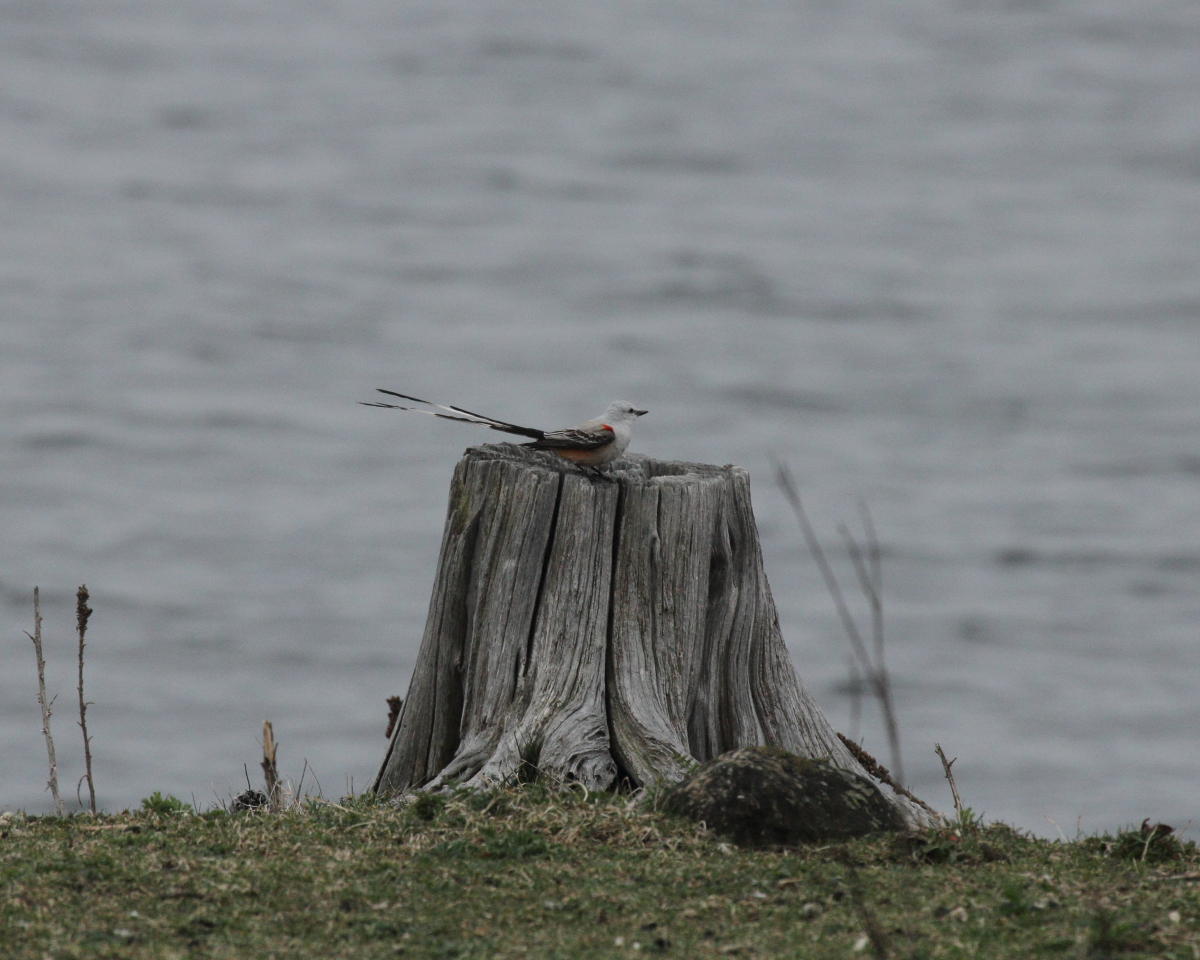
Scissor-tailed Flycatcher

Wouldn't you know it, we get a weekend with lots of south winds and I am stuck in a classroom attending a course all day Saturday and Sunday.  Well, I managed to finish early today and headed straight for the Scissor-tailed Flycatcher that was reported yesterday by Terry Sprague, near Demorestville.

When I arrived I was told by the friendly lady who owns the property the bird was south across the field by the small lake and I was welcome to walk across!  After walking across the field I quickly saw the bird - beauty! Also got my first of the year Swamp Sparrow here, bonus!  Here's the full eBird checklist and some photos:


I am pretty sure this is an adult (definitive alternate) male.  Definitely a male by the bright red underwing and the large notch on the outer primary (P10).