I grew up in southwestern Ontario and not surprisingly, that biased my view on birds and their movements and populations in the province. I don't think there is a better example of this than my view of goose migration.
For most of my life, I thought seeing several hundred or even a thousand Canada Geese was a good flock. And sure enough, scrutiny of any "good-sized" flock (read: a few hundred) in my neck of the woods has a pretty good shot at turning up "something good", usually Cackling or Snow Geese or maybe if you're really lucky a Greater White-fronted or Ross's.
Big or small flock? Depends on where you're from! Spot the Cacklers?
My eyes were opened when I started hanging around this girl, Erica and her family's farm southeast of Ottawa. Turns out what I thought was a lot of geese was pretty sad. Not a day goes by in far southeastern Ontario during migration season when you can't easily find tens of thousands of geese in the air or in the farm fields.
My view of Ontario goose migration, like so many other southern Ontario-centric birders, was extremely flawed. Southeastern Ontario is on a huge goose flyway along the Atlantic coast. In recent years, as the Greater Snow Goose migration has increased in southeastern Ontario, awareness of this seems to be increasing, but still most Ontario birders really don't appreciate how different goose migration is in the southeast.
Greater Snow Geese near Cornwall
This really revealed itself to me while on the OBRC and the committee was discussing a record of Barnacle Geese outside of Ottawa. In short, I am of the belief that Barnacle Goose occurs as a natural vagrant in this part of the province but some people, largely because of their southwestern Ontario view of goose migration, disagree. So, I decided to compile some information...that spiraled a bit out of control and before I knew it I had a decent article for Ontario Birds.
Anyways, this is all to say that I am happy with an article I recently wrote for Ontario Birds. Here are a couple of figures to get you thinking:
Canada Geese banded in Greenland and recovered or re-sighted in Canada and the United States. Prepared using data obtained from the Canadian Wildlife Service Bird Banding Office.
You might notice a similarity with this:
Barnacle Goose reports in eBird for northeast US and Canada.
If you're an OFO member check out the article in the December issue of Ontario Birds. If you're not...why not? (email me and I can send a pdf)
Looking forward to hearing your feedback on this one!
Yesterday afternoon Janice Grant found a Thick-billed Murre on the Kingston waterfront. She called Mark Read who was able to confirm it as a Thick-billed Murre, follow it as it swam east along the lake shore and get a few local birders on it (side note, in two weeks Erica and I will become local birders in Kingston!). Mark posted to Ontbirds late in the day and not surprisingly many birders made plans to be there for first light.
I wasn't one of them because I had a meeting in the morning (which was cancelled due to the weather) but once the freezing rain cleared I made it out to try my luck before working the rest of the day from a local library. Initially when we arrived my heart dropped a bit because there were only two birders present and all I saw were a couple of Common Loons in the harbour. However, a couple seconds later and I realized I was looking too far away - the bird was only about 20ft from the birders!
Needless to say, great views of this rare bird
I even took a short video - Erica's commentary sums it up:
Apparently, Thick-billed Murre used to occur semi-regularly on Lake Ontario in late fall/early winter but that hasn't been the case since the 1950s
The Birds of Hamilton by Bob Curry has a good summary of Thick-billed Murre in Ontario listing records from about a dozen years before the mid 1950s, some with fairly extensive "wrecks" of multiple birds.
[EDIT: Thanks to Glenn Coady for the following references if you are interested in Thick-billed Murre history: Fleming,
J.H. 1907. The unusual migration of Brunnich's Murre (Uria lomvia) in
eastern North America. Proceedings of the IV International
Ornithological Congress, pp. 528-543.
Hoyes Lloyd's review of the Birds of Ottawa: Lloyd, H. 1923. The birds of Ottawa, 1923. Canadian Field-Naturalist 37: 101-115; 125-127; 151-156. Lloyd, H. 1924. The birds of Ottawa, 1923 [conclusion]. Canadian Field-Naturalist 38: 10-16 Lloyd, H. 1944. The birds of Ottawa, 1944. Canadian Field Naturalist 58: 143-175.]
However, since then there have only been two documented records for Ontario: 1995: 5-6 December, Deschenes Rapids, Ottawa River, Ottawa. Found by Bruce Di Labio 1998:
29 November, Burlington Ship Canal, Hamilton. Found by Robert M. Sachs,
Sheila Bowslaugh, Eleanor Sachs, and Carl J. Rothfels
The Ottawa record apparently was originally identified as a Razorbill (pretty easy to do when it isn't at your feet!) and it wasn't realized what it was until the morning of December 6. Since many birders already had Razorbill on their Ontario lists many missed out on this bird even though it was technically chase-able. Even relatively local birders missed this bird for that reason because there was only a couple hours between when its real identity was realized and the time it disappeared [edit - according to an anonymous comment it was killed by a Gyrfalcon!!].
The birding in southern Ontario since mid-April has been great, to say the least with a long list of rarities having shown up. I've been lucky enough to connect with more than my fair share and I have been very happy for that. The last two have had something in common - they were both associating with flocks of White-crowned Sparrows.
White-crowned Sparrow in Polar Bear Provincial Park last summer
The first of these rarities was a young male Blue Grosbeak on Pelee Island. It was found during the Pelee Island bird race (AKA Botham Cup) by Paul Carter. Unfortunately, Paul wasn't on a team and though he waited for one of the 7 teams to pass him, none did, so no teams got it for the tally. Most of them (including us) headed to there right after the race ended at noon on Saturday and got looks at this bird. It was pretty elusive, alternating between the thick hedgerow and the grassy field that was just high enough to hide the bird. It stuck around until at least May 13 (3 days) and on May 12 I got a few "record" shots of this bird:
This was a really nice bird to get and it was only my second ever (the first was a female I found at the Tip of Long Point on May 6, 2004). I think the photos of the more recent Blue Grosbeak might be a bit better....
The next nice bird to get was today. I was headed into Prince Edward County to check out some spots when I saw the post on Ontbirds advising that a Lark Bunting had been found by Mark Saunders at his home near Sharbot Lake. I decided to do some birding in the county first, then head north. I got on site a little after 1pm and I was greeted by Mark himself. He told me the story about how he heard this strange song that reminded him of a mockingbird at 5am and when he went outside to investigate it turned out to be a Lark Bunting. Amazingly, Mark had a Lark Sparrow at the same spot a couple years ago. His farm is small but it is one of the only open field habitats in a sea of Canadian Shield forest for many kilometres in each direction.
Anyways, back to the bird. The Lark Bunting was hanging out in a fairly small area near the actual house, usually with White-crowned Sparrows and after about 1 or 2 minutes of Mark telling me the story and showing me some of the places it had been seen the bird popped up and flew in front of me! Obviously, it is a pretty distinctive bird with those big 'ol white wing patches and I got my camera out right away. I managed a few shots and even one video of it. Overall I was a bit surprised at how small it was (certainly no bigger than the White-crowned Sparrows it was with), expecting something a bit bigger but that didn't bother me!
For some reason Blogger isn't letting me embed my YouTube video, so here's the link: http://youtu.be/kaqIEzjwXfw
Well, it goes to show you, it is definitely worth checking through those flocks of common birds!
Erica and I headed to tropical Ontario yesterday and camped at Rondeau; we picked up lots of new arrivals for us and then spent a couple hours birding the park this morning after camping over last night. It was a really nice day already and we headed out at 10 towards Pelee. That's when the excitement really happened!
Just after passing through Port Alma a bird appeared in the air beside someone's house.....and I yelled to Erica "Swallow-tailed Kite!!!" Wow, what a sweet bird as it lazily kited around the trees in the yard and then started moving NW into the field. After some frantic phone calls the bird started heading west down the road....so we followed it! Erica got the word out on Ontbirds as we watched as it gracefully flew back and forth over our heads, checking out each grove of trees it came to. After doing this for a few minutes the bird started picking up speed and just basically b-lining west along the lake shore. And I mean RIGHT along the lake shore - presumably getting some lift from the bluffs and with a nice tail wind. At times I had the car doing 60 km/h just keeping up with it! After about 30 minutes Ken met up with us frantically heading east and we got him to turn around and follow us and the bird. The bird had gotten ahead of us so we dumped his car (windows open and keys in the ignition!!!) and found a good spot to look for the bird. Sure enough we picked it up over Wheatley Provincial Park.
Since the bird was now well to our west we decided to leave the bird and to backtrack to get Ken's car. After getting through Wheatley and passing Hillman Marsh amazingly we picked it up again as it miraculously appeared directly overhead on Mersea Road E, where we lost it as it disappeared over the marsh before we could get up over the dyke that borders the Pelee marsh. A few minutes later the crowd that had gathered at the visitor centre parking lot had the bird obligingly come right overhead as it headed south (apparently David Bell's calculated time was within seconds!).....as far as I know that was the last it was seen so it either snuck back north or made the crossing over Lake Erie...
Anyways, pretty sweet bird! Here are some pics:
I'm sure Brandon and David (and lots of others who waited patiently at the VC for the bird!) will some some pictures on their blogs...
And of course some eBird checklists with location info:
Well if you follow birds in Ontario at all this post doesn't need an introduction.
Last night Bill Gilmour found a Thick-billed Kingbird at Presqu'ile Provincial Park!!! That's an insanely rare bird to show up in Ontario - basically a western Mexico breeder that barely extends into Arizona. Outside of the extreme SW part of the US there is apparently a record for Colorado and British Columbia, which would make this Ontario record the first eastern NA record! (Check out the eBird range map). Needless to say, a lot of birders' plans for today changed pretty quickly! Luckily for me I now live only about 30 mins away from Presqu'ile and even luckier I had already booked Wednesday off to do some birding at Presqu'ile in the morning (and then back home to make dinner for Erica's whose birthday it is!!).
Ken, Brandon and Josh met up at my place late last night (actually early this morning). We all got some sleep and then headed out. We arrived just as it was getting light out. After a few minutes of chatting with some of the other birders there the bird in question obligingly announced its presence with its distinctive call as it left its overnight roost. For the next hour and a half everyone there enjoying excellent looks as it foraged from the tops of some dead trees. It had a success rate of capture at least in the 90 percent range and all the prey we could ID seemed to be bees/wasps- the BNA account doesn't have any info on prey preferences but we wondered if that honkin' bill is a wasp-killing adaptation? Here's some photo evidence of the bird:
There was lots of discussion about the age of this bird and I have to say I was leaning towards this being an "old" bird while in the field because it was so worn. After doing some reading and looking at my photos (the middle photo above shows the state of the wing well) I think it is likely a juvenile bird. All the wing feathers and outer rectrices look incredibly worn (so perhaps that suggests this is a bird born early this year, perhaps from the more southern part of the species range). It is amazing to see how worn some of these feathers are already for a bird that likely isn't more than half a year old yet.
NOTE: I stand corrected. After research and discussion amongst others the consensus is that this is an adult (after second year) bird that has yet to undergo its prebasic moult, which is usually completed on the wintering grounds. Based on the shape of P10 (check out Brandon's picture of the bird in flight) this would also be a female.
Anyways hopefully more photos and people with more experience with these matters will come to the same conclusion....Another cool feature of this bird that I captured (in the third image) is the yellow crown patch.
Here's a short video of the bird which includes some calling (by the bird) and lots of birders excitedly talking about random stuff:
The calf pasture area was really hopping with birds while we watched the kingbird. Passerines were steadily moving west overhead and lots were landing in the trees. Here's our eBird checklist for that spot.
We checked Owen Point trail afterwards but it was pretty quiet. We did have one really good sightings though- a flock of 18 Red Crossbills going north overhead. Apparently there seems to be a movement a foot of these guys....Here's our checklist from Owen Point.
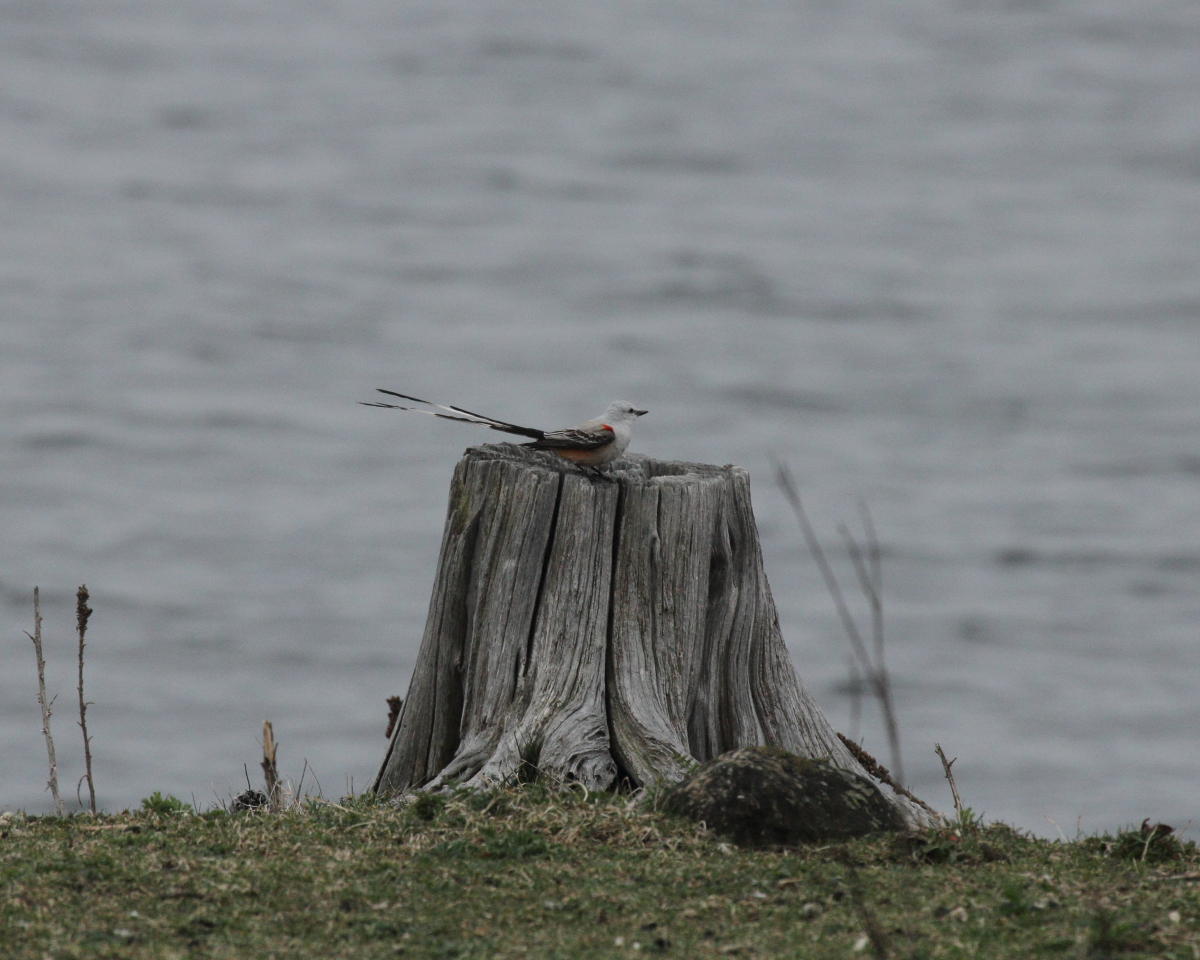
Wouldn't you know it, we get a weekend with lots of south winds and I am stuck in a classroom attending a course all day Saturday and Sunday. Well, I managed to finish early today and headed straight for the Scissor-tailed Flycatcher that was reported yesterday by Terry Sprague, near Demorestville.
When I arrived I was told by the friendly lady who owns the property the bird was south across the field by the small lake and I was welcome to walk across! After walking across the field I quickly saw the bird - beauty! Also got my first of the year Swamp Sparrow here, bonus! Here's the full eBird checklist and some photos:
I am pretty sure this is an adult (definitive alternate) male. Definitely a male by the bright red underwing and the large notch on the outer primary (P10).